



May 2026 | Burma Independent Voice
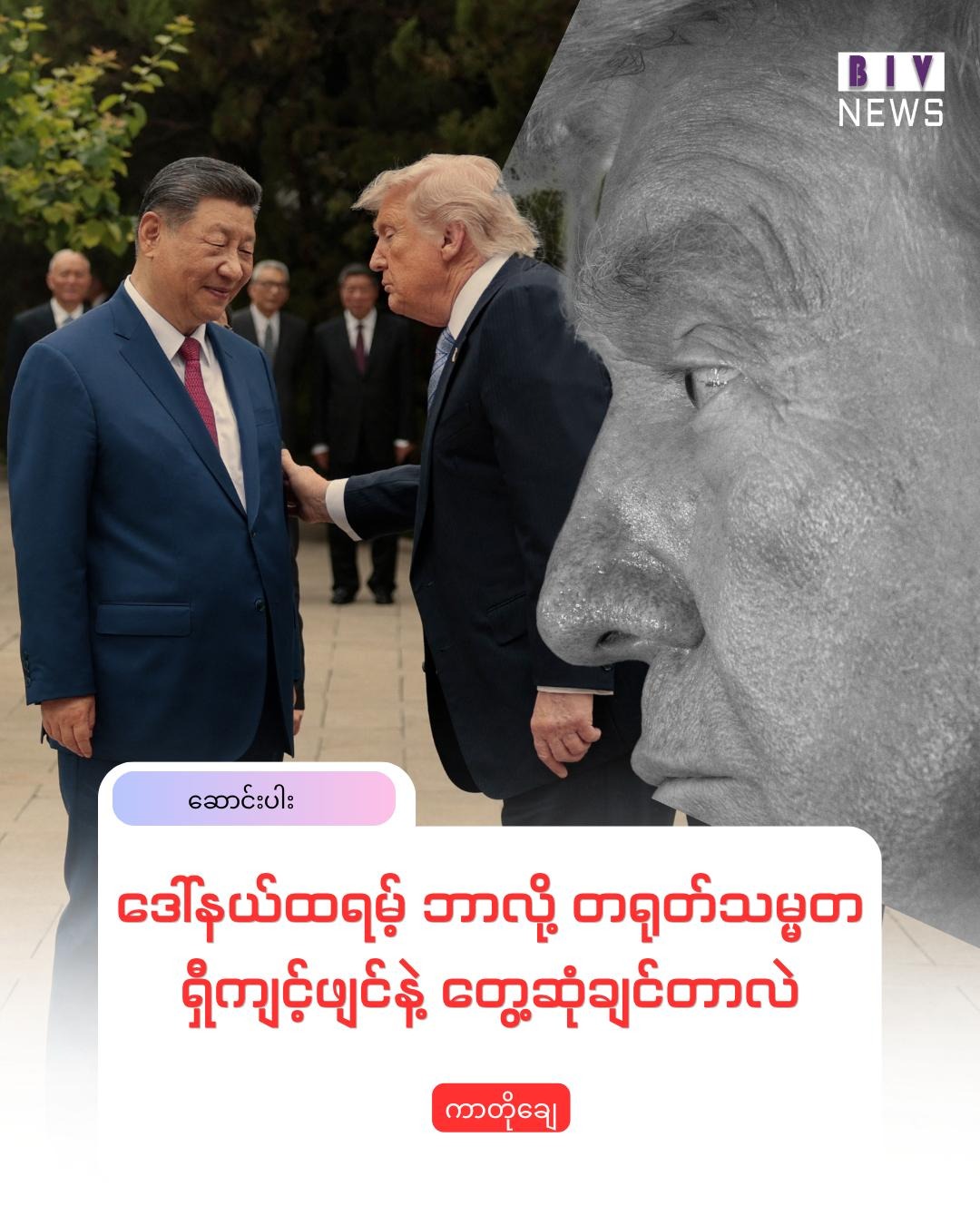
Donald Trump traveled to China this May to meet with Chinese President Xi Jinping, marking the first visit by a sitting or incoming U.S. president to China since 2017. Notably, this summit was not initiated by the Chinese side; rather, it was explicitly requested by Trump himself.
This raises a crucial question: Why was Trump so eager to travel to China and meet with President Xi? The short answer lies within the U.S. economy. Trump initiated a trade war against China during his first term in 2018. However, his move to drastically escalate this trade war during his second term in 2025 has ultimately backfired on the United States.
The U.S. economy is currently grappling with significant inflation, which has severely weakened the purchasing power of American workers. Trump’s aggressive trade war policies and tariff hikes have only worsened these conditions. Consequently, the U.S. foreign policy establishment—including the Council on Foreign Relations (CFR)—now widely acknowledges that China holds the upper hand in these negotiations.
Accompanying Donald Trump on his delegation to China were some of America’s most powerful billionaires and corporate executives. The lineup included Tesla CEO Elon Musk, Nvidia CEO Jensen Huang, Apple CEO Tim Cook, Blackstone CEO Steven Schwarzman (the head of the world’s largest alternative asset management firm and a major donor to Trump’s presidential campaign), and BlackRock CEO Larry Fink. Chief executives from Boeing, Cargill, Citigroup, GE Aerospace, Goldman Sachs, Micron, and Qualcomm also joined the delegation.
With a population of 1.4 billion, China stands as the world’s second most populous nation just behind India. It also boasts the world’s largest middle class, numbering over 800 million people with a combined spending power of 7.4 trillion dollars—substantially larger than the middle-class markets of the U.S., India, or any other nation. The U.S. government’s trade war against China has enjoyed strong bipartisan support, persisting through both Trump’s first term and Joe Biden’s administration.
However, this ongoing trade war has severely crippled many top U.S. corporations. Nvidia CEO Jensen Huang, who has visited China multiple times over the past few years, is desperate to regain access to the Chinese market. The stakes are incredibly high: Nvidia once controlled 95% of China’s advanced microchip market, but that market share has recently plummeted to 0%.
This drop from a 95% market share to zero is precisely why Jensen Huang joined Trump’s delegation. Under both the first Trump administration and the Biden administration, the U.S. government imposed strict export controls on advanced semiconductors. The primary goal was to stall China’s AI development and prevent it from catching up to the U.S. technology sector. Yet, Beijing did not simply stand by and watch Washington attempt to dismantle its high-tech ambitions.
Instead, the Chinese government invested hundreds of billions of dollars in low-interest loans, subsidies, and state support to build up its domestic semiconductor industry. In just a few years, China made monumental strides. While Chinese manufacturers may not yet match the exact technical sophistication of Nvidia’s top-tier products, China now completely dominates the global market for “legacy chips”—the slightly larger, foundational semiconductors, rather than the cutting-edge 3-nanometer or 5-nanometer chips. Given this rapid trajectory, China is well-positioned not just to match but potentially surpass the U.S. tech sector in the coming years. This has led American tech executives like Jensen Huang to argue that the trade and tech wars have become entirely counterproductive—offering a minor short-term buffer while inflicting massive, long-term damage on American businesses. This realization is driving corporate leaders to collaborate with Trump to forge a new strategy, reflecting a massive shift in the global economic landscape.
Over the past few decades, China has evolved into the world’s indispensable manufacturing hub, rendering it the sole manufacturing superpower. Today, China alone accounts for nearly one-third of global manufacturing output—a figure that surpasses the combined manufacturing power of the United States, Japan, Germany, and South Korea.
As the U.S. economy shifted heavily toward financialization and deindustrialization over recent decades, major American corporations outsourced their manufacturing pipelines abroad, primarily to China. Today, China sits firmly at the center of the global supply chain for advanced manufacturing. While U.S. companies like Apple have attempted to diversify their production outside of China, the reality on the ground makes a total exit nearly impossible.
Across the Obama, Trump, and Biden administrations, Washington consistently pressured American firms to pull investments from China and relocate to countries like India. However, China’s deeply integrated and highly sophisticated supply chain ecosystem has kept these companies anchored. China possesses an unparalleled network of domestic suppliers capable of providing everything from minute components and specialized machinery to refined minerals. Coupled with a massive pool of highly skilled labor, completely leaving China remains an unrealistic option for these corporate giants. Tesla serves as a prime example of this dependency.
Tesla CEO Elon Musk, the world’s wealthiest billionaire, was the single largest donor to Trump’s 2024 presidential campaign. Yet, more than half of all Tesla electric vehicles (EVs) are manufactured at its Gigafactory in Shanghai. In a twist of irony, while Musk relies on China to produce half of his fleet, he simultaneously lobbied Washington for protectionist barriers to shield Tesla from Chinese competition in the U.S. domestic market.
During the Biden administration in 2024, Musk pushed for trade barriers to protect Tesla’s domestic market share. Weeks later, Biden announced a 100% tariff on Chinese electric vehicles. While this move effectively blocked Chinese EVs from entering the United States and allowed Tesla to maintain its domestic dominance, Chinese EV manufacturers like BYD have gone on to dominate the rest of the global market.
BYD has since overtaken Tesla as the world’s top-selling EV manufacturer. The shift prompted the CEO of Ford to warn that Chinese competitors possess the structural capacity to potentially drive traditional U.S. automakers out of business. These underlying economic realities explain why the Council on Foreign Relations noted in Foreign Affairs magazine that Beijing held distinct structural advantages over Washington heading into the Trump-Xi summit.
According to an article in Foreign Affairs penned by a former U.S. official who served in both the State Department and the National Security Council, the U.S. has lost significant leverage over China. To understand how this happened, one must look back to April 2025, when Trump announced sweeping global tariffs on what he termed “Emancipation Day,” with China as his primary target.
At one point, Trump threatened temporary tariffs on Chinese goods reaching as high as 145%—amounting to a near-total trade embargo. However, Trump was ultimately forced to de-escalate. By October 2025, he met with the Chinese president and agreed to a one-year truce in the trade war. This retreat was a tacit acknowledgment that the U.S. was losing the economic conflict. The trade war, initiated during Trump’s first term, sustained by Biden, and aggressively expanded at the start of Trump’s second term, had reached a tipping point after nearly a decade: Washington had exhausted its economic leverage, and Beijing had successfully adapted.
Major American media outlets have increasingly acknowledged that the U.S. trade war against China has inflicted severe self-inflicted wounds. Analysts point out that U.S. policymakers significantly underestimated China’s resilience, operating under the arrogant assumption that Washington held all the leverage. In April 2025, as a new phase of the trade war began, Trump’s Treasury Secretary—Wall Street billionaire and hedge fund manager Scott Bessent—proclaimed on television that the U.S. held all the cards while China was playing a losing hand. The ensuing months proved the exact opposite.
China actually held substantial leverage because it had spent the previous decade diversifying its economy and global trade networks. Washington had long assumed that the Chinese economy could not survive without access to the U.S. consumer market. While that might have been true in the 1990s—when a quarter of China’s trade was tied directly to the U.S.—the landscape has fundamentally changed since 2016. Today, the United States is no longer China’s most critical export destination. In fact, China now conducts more trade with the ASEAN bloc (Southeast Asian nations) than it does with either the U.S. or the entire European Union combined. Southeast Asia and the broader Global South have emerged as Beijing’s primary trading partners.
Trump believed he could simply choke off China’s access to the U.S. market with high tariffs and force Beijing to yield to all of Washington’s demands—a tactic that had succeeded with smaller nations. However, China became one of the few powers to actively deploy effective counter-measures against unilateral U.S. tariffs.
In a major retaliatory move, Beijing announced strict export controls on rare earth elements. This sent shockwaves through the U.S. tech sector and the military-industrial complex, both of which are profoundly dependent on critical minerals and rare earths sourced from China.
This dependency has given China immense strategic leverage. It was a central talking point during the October 2025 meeting between Trump and Xi, and it remains the dominant issue in the May 2026 negotiations. The reality is simple: modern advanced technology cannot be manufactured without rare earth elements, and China completely controls the global supply chain for these materials.
China’s dominance extends far beyond rare earths. It plays a massive, central role in the production and refining of other critical industrial metals, including copper, nickel, aluminum, lithium, and cobalt. When it comes to rare earths, manganese, and graphite, China’s monopoly is virtually irreplaceable. When Beijing activated these export restrictions in response to Washington’s trade hostilities, it dealt a severe blow to American tech giants and defense contractors alike.
The U.S. military relies heavily on critical minerals mined and refined in China to sustain its defense systems; without access to these materials, American defense manufacturing faces immediate bottlenecks. This reality led Foreign Policy magazine to observe that China’s “rare earth card” heavily dominated the dynamics of the Trump-Xi summit.
Over the past few years, the U.S. government has focused intensely on building alternative supply chains for critical minerals. This initiative began during Trump’s first term, accelerated under Biden, and continues under Trump’s current administration. Just this past February, Trump’s Secretary of State, Marco Rubio, hosted an “International Critical Minerals Ministerial Meeting” in Washington, inviting representatives from numerous nations to collaborate on establishing a supply chain that completely bypasses China.
The Trump administration has also introduced a framework dubbed “Pax Silica,” an initiative aimed at uniting the U.S. and its closest allies to build an exclusive supply chain centered on advanced semiconductor manufacturing. Washington successfully pressured India into joining this Pax Silica alliance, promising to help divert American corporate investments and factories out of China and into Indian hubs or allied nations. However, decoupling an economic ecosystem of this scale is a project that will take years, if not decades, to realize. It cannot be achieved in a matter of weeks or months. Consequently, for the immediate future, the United States has little choice but to negotiate and cooperate with China.