



May 19, 2026 | Burma Independent Voice
Human Rights Watch (HRW) has released a comprehensive investigative report detailing a mass killing perpetrated by the Arakan Army (AA) against hundreds of Rohingya Muslims in Thanshouk Khan Village, Buthidaung Township, in May 2024.
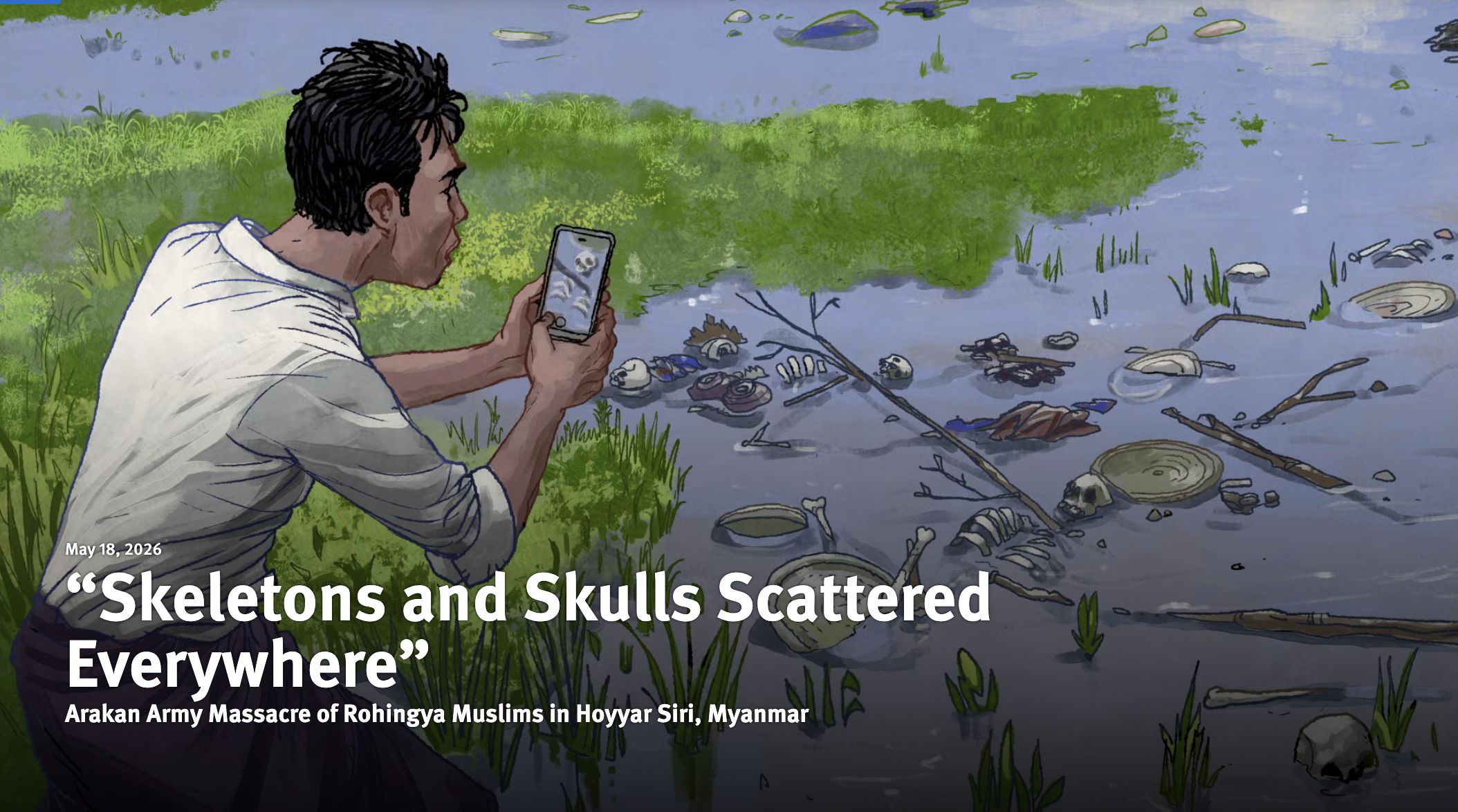
The report, titled “Skeletons and Skulls Scattered Everywhere,” is based on interviews with 41 eyewitnesses, satellite imagery analysis, and the verification of social media footage by digital experts.
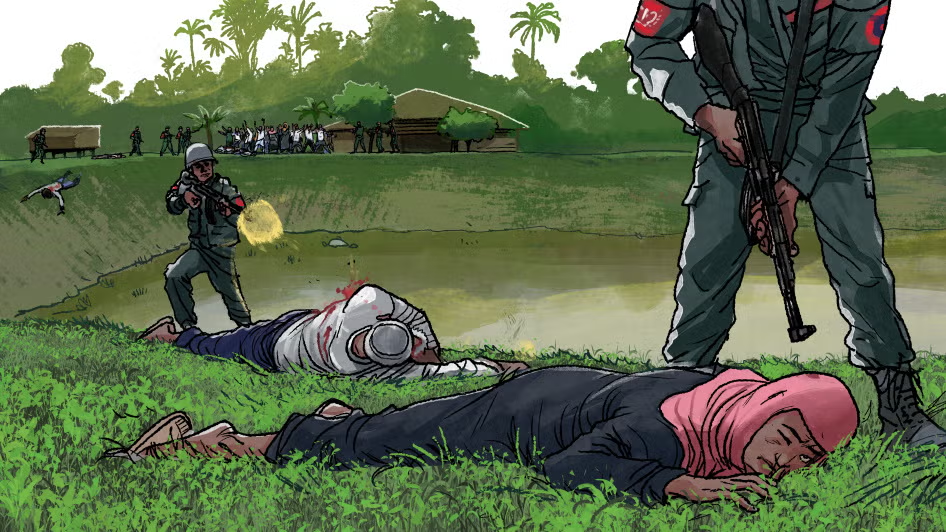
According to HRW, on the morning of May 2, 2024, as clashes intensified between the advancing AA forces and the Myanmar military, unarmed civilians carrying white flags attempted to flee toward Buthidaung town. AA fighters reportedly surrounded and opened fire on the retreating crowd in fields and along roads without prior warning.
Through its investigation, HRW has confirmed the identities of at least 170 Rohingya who were killed or went missing during the incident, including 90 children. However, survivors who recently managed to cross the border into refugee camps in Cox’s Bazar, Bangladesh, estimate that the actual death toll could be as high as 500. It was only after these survivors reached safety that the full scale of the atrocities began to surface, over a year after the massacre took place.
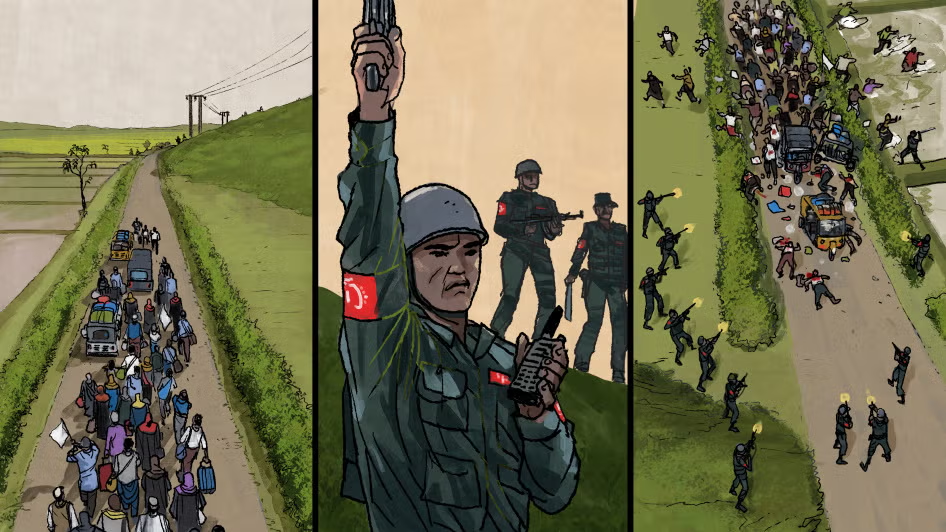
The report highlights Thanshouk Khan Village, situated along the Buthidaung-Rathedaung road, as one of the deadliest flashpoints of the conflict. The village was caught in a geographic trap, bordered by the junta’s Operation Command Headquarters No. 15 (MOC-15) to the north and Light Infantry Battalion 551 (LIB-551) to the southeast, leaving residents pinned between both warring factions as frontlines closed in.
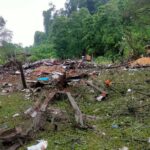
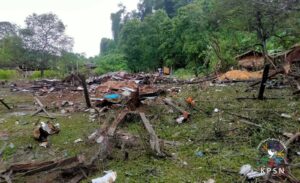
One witness, Omar Ahmed, recounted sneaking back into the village months after the massacre, describing a grim landscape where bodies had decomposed, leaving skeletons and skulls scattered across open fields.
The report further reveals that the United League of Arakan (ULA), the political wing of the AA, has denied responsibility for the massacre. HRW discovered that the group forced captured civilians to film staged video testimonies stating that the AA was not involved in the killings.
Furthermore, HRW documented that many fleeing civilians intercepted by the AA were placed in temporary internment camps. These sites are tightly guarded, with residents denied freedom of movement and subjected to forced labor, including road construction and stone-breaking.
HRW strongly condemned the AA’s actions, stating that deliberate attacks on civilians, torture, and punitive arson constitute clear war crimes under the Geneva Conventions. At the same time, the report faulted the Myanmar military for violating the laws of war by forcibly conscripting Rohingya men to use as human shields and failing in its legal obligation to protect civilians under its control.
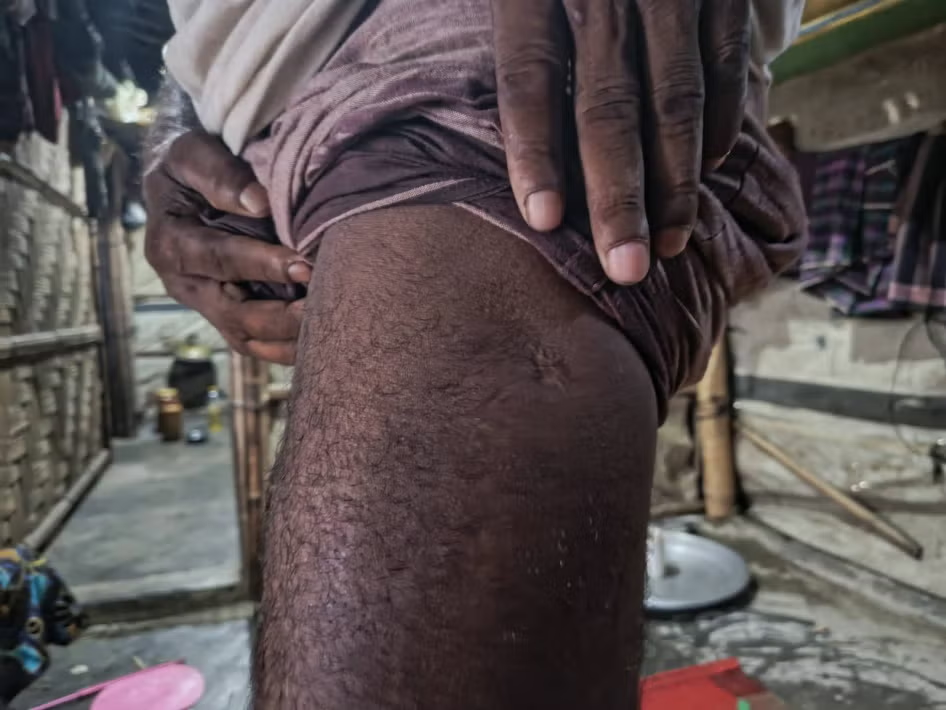
The investigation notes that in mid-April 2024, a Myanmar military captain demanded 20 Rohingya “volunteers” from the village to fight against the AA, threatening to burn the village down if they refused. Under duress, villagers sent at least 12 men. The military had also formed local alliances with Rohingya armed groups like the Arakan Rohingya Salvation Army (ARSA). This forced conscription and the visible presence of ARSA within the area heightened villagers’ fears that they would be targeted collectively by the AA.
When the fighting neared the village, residents attempted to evacuate, but junta soldiers blocked their exit, declaring, “If you die, we die,” and ordering them to remain hidden in bunkers inside the village.
In light of these findings, HRW has called on the UN Security Council to refer the situation in Myanmar to the International Criminal Court (ICC) so that both the state military and all non-state armed groups committing atrocities against civilians can face justice. The organization also urged international donors and ASEAN to apply coordinated pressure to guarantee civilian protection in Rakhine State.
The report concludes with an urgent appeal to the Arakan Army to strictly adhere to international humanitarian law, immediately halt targeted attacks on civilians and civilian property, disband forced labor camps, and allow detained Rohingya to safely and voluntarily return to their places of origin. Simultaneously, it reiterated that the Myanmar military must cease its ongoing campaign of airstrikes, deliberate civilian targeting, forced conscription, and the illegal use of human shields.