
April 10, 2026 | Burma Independent Voice (Fact Check)
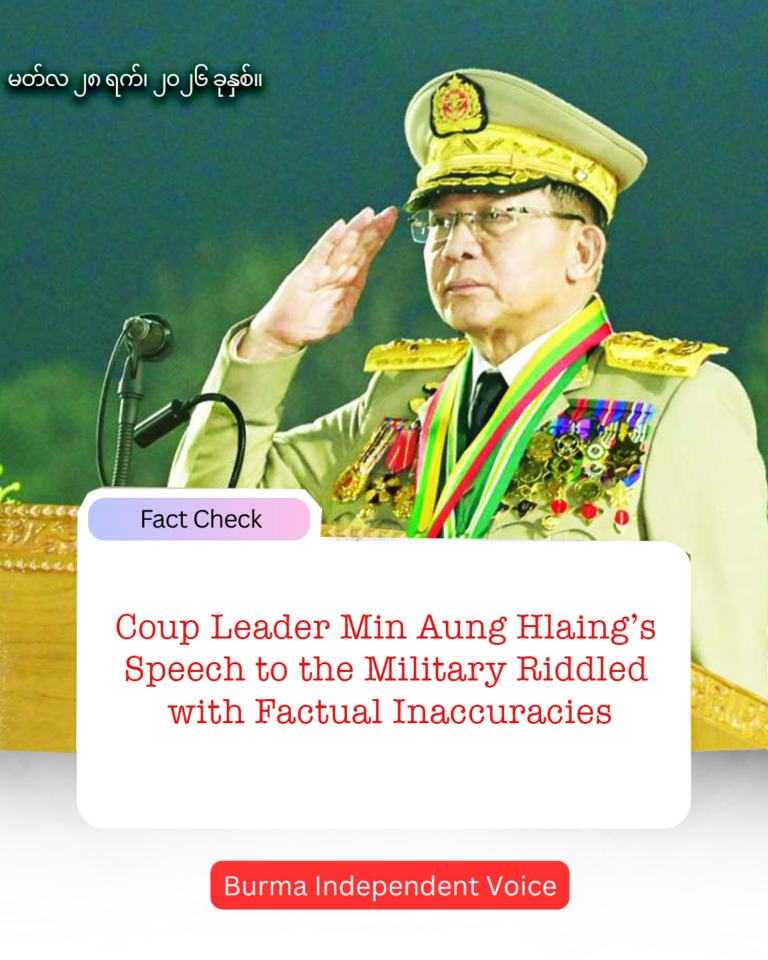
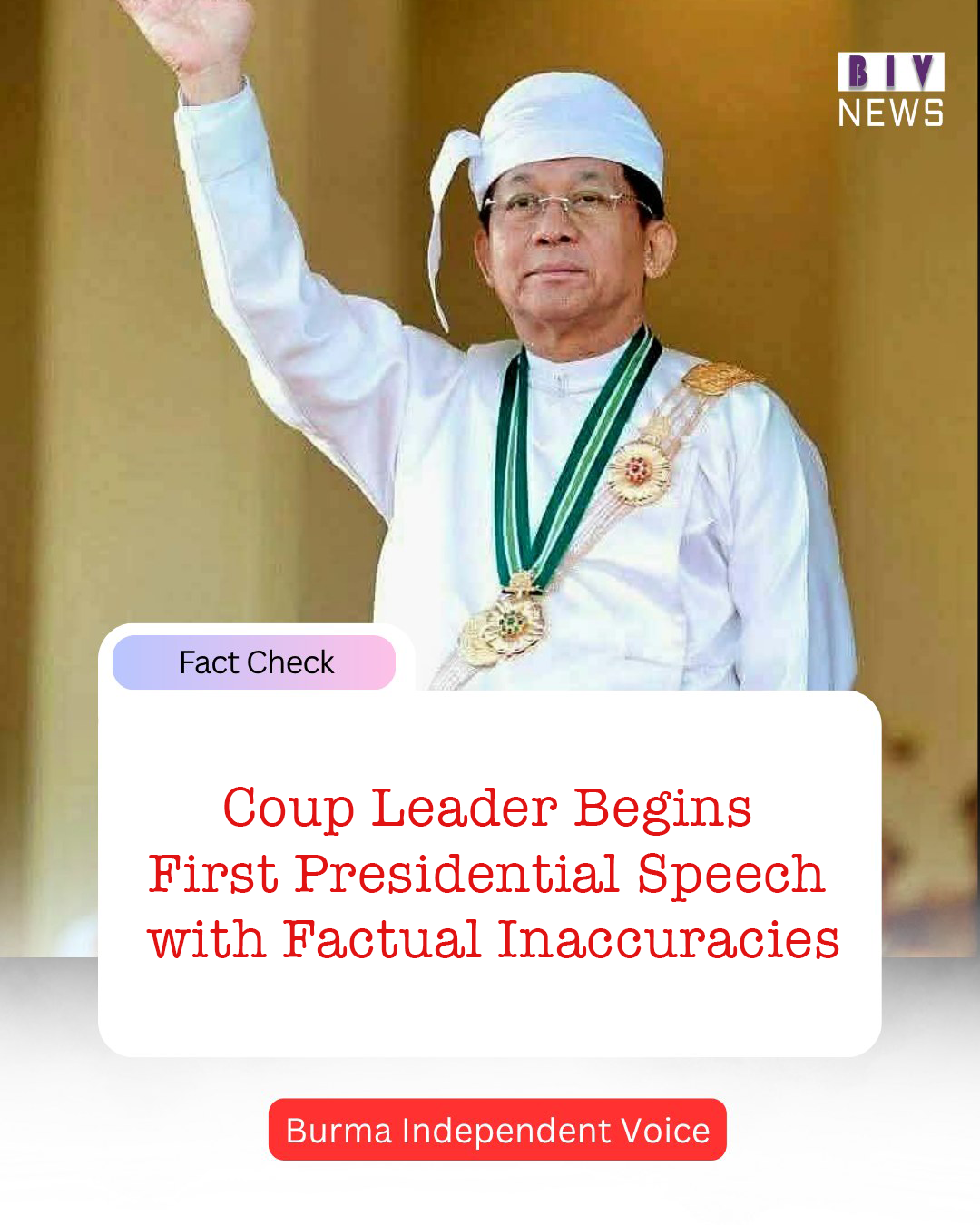
Coup leader Min Aung Hlaing, appearing in the military-dominated Union Parliament following an election tailored by the military, delivered a presidential speech marked by several factual inaccuracies. BIV has fact-checked the following claims made by the coup leader.
Claim 1: Fraud in the 2020 General Election
Coup Leader’s Statement: “In the 2020 multi-party general election, the then-ruling party engaged in such ugly and massive electoral fraud that the election failed to be fair and honest—the very essence of democracy—and instead pursued a dishonest political path that undermined the multi-party democratic system.”
Fact Check: This contradicts the facts. Both domestic and international election monitoring organizations reported that the 2020 general election was free and fair. The international community also recognized the election as representative of the people’s will.
The People’s Alliance for Credible Elections (PACE) released its final monitoring report on March 16, 2021. While the report noted administrative weaknesses and irregularities, it concluded that these did not have an impact capable of changing the overall election results. Read PACE Report: https://archive.ph/R5vkj
Furthermore, on January 29, 2021, a group of domestic election monitoring organizations issued a joint statement confirming that the 2020 election results reflected the will of the majority of voters. They noted that despite challenges posed by the legal framework and COVID-19 restrictions, the outcome remained legitimate. Read Joint Statement: https://archive.ph/F7uov
While the coup leader repeatedly alleges fraud, independent observers have consistently debunked these claims. Contrary to his claim that “dishonest politics” undermined democracy, both the Myanmar public and the international community view the military coup itself as the primary cause of the destruction of Myanmar’s democratic path. International leaders, including those from the U.S., have called for the recognition of the 2020 results and the immediate release of detained leaders, including Daw Aung San Suu Kyi.
Claim 2: Legality of the Coup
Coup Leader’s Statement: “Since our demands were ignored and the fraud remained unresolved, there were attempts to seize state power through unfair results and an illegitimate parliament. Therefore, the military had to assume state responsibilities after a state of emergency was declared in accordance with the Constitution.”
Fact Check: This is false. Legal experts have pointed out that the 2021 coup violated the 2008 Constitution. Under Section 402 of Chapter (9) regarding the election process, the decisions and actions of the Union Election Commission (UEC) regarding electoral matters, appeals, and revisions are final and conclusive. The Constitution grants the UEC the authority to resolve disputes and provides no legal mandate for the military to intervene in election matters.
Furthermore, Chapter (3), Section 71(b) stipulates that any impeachment of the President must be initiated by at least one-fourth of the members of either house of the Union Parliament. The Constitution does not grant authority to arrest the President without such proceedings. The military’s arrest of President U Win Myint and State Counsellor Daw Aung San Suu Kyi on February 1, 2021, prior to the declaration of a state of emergency by Vice President Myint Swe, was a clear violation of the 2008 Constitution by the military itself.
Claim 3: Credibility of the 2025 Election
Coup Leader’s Statement: “Following provisions for the emergency period, we have now successfully held a free, fair, and dignified multi-party democratic election in accordance with the will of the people.”
Fact Check: This contradicts the reality. The 2025 military-led election could not be held nationwide. According to a report by Data For Myanmar, the military-appointed Election Commission announced on December 5 that elections would not be held in 2,931 wards and village tracts across 202 townships scheduled for Phases 1 and 2.
While the coup leader describes the election as “fair and dignified,” reports indicate it was marred by a massive influx of advance votes, mirroring the 2010 election, which favored the military-backed Union Solidarity and Development Party (USDP). Analysis of Phase 1 results in 81 townships showed that in 80 of those townships, the USDP alone received more advance votes than all other parties combined. Of the USDP’s 2 million total valid votes, 17% (342,642 votes) were advance votes. Read Data For Myanmar Report: https://tinyurl.com/4jven54e
The election was also conducted under heavy coercion. According to the military-appointed UEC’s own data, at least 335 individuals were arrested under election laws for criticizing the process, severely restricting freedom of speech. Furthermore, the 2020 election-winning party, the National League for Democracy (NLD), and several other political parties were barred from participating, rendering the election non-representative of the people’s will.
About the Author