
Article | Burma Independent Voice
By Kyaw Ba
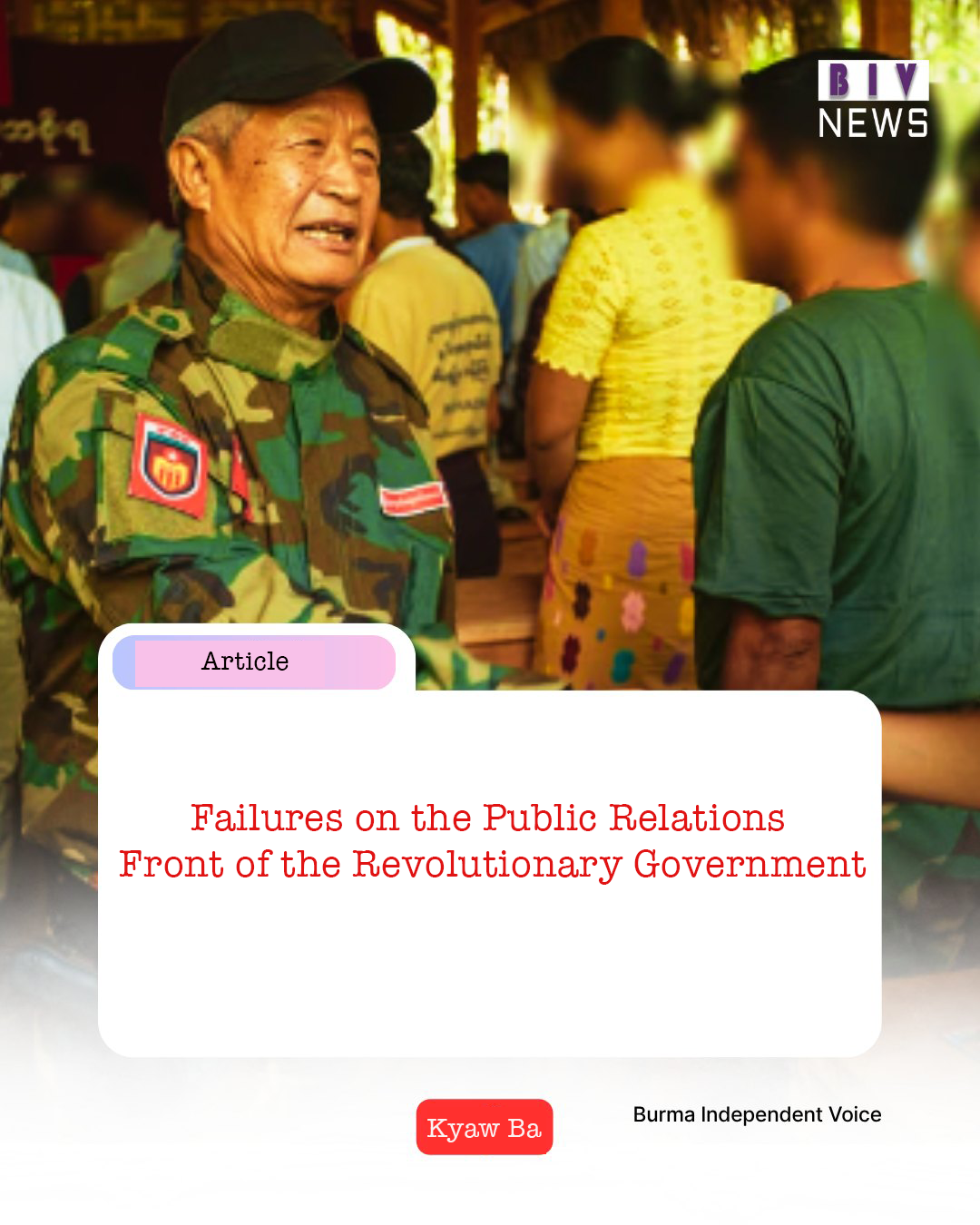
The Myanmar revolution is naturally progressing through a series of victories and losses on the physical battlefield. However, the National Unity Government (NUG), acting as the vanguard of the revolution, faces immense challenges in the arena of Public Relations (PR) Warfare. Alarmingly, the narratives the revolutionary government intends to communicate to the public are failing to reach them swiftly or widely. Instead, the propaganda of opposing forces is gaining significant ground—a warning bell that should concern the entire revolution.
To accurately assess the current situation, we must look beyond the individual performance of personnel and focus on deeper Structural Constraints and System Failures. This “Narrative Incompetency”—where intended messages fail to resonate with the public—is a multifaceted issue ranging from infrastructure deficits to the NUG’s broader psychological warfare strategy.
Firstly, we must acknowledge that the NUG is fighting an asymmetrical battle. The military holds the state apparatus, including MRTV, Myawaddy, and the Myanmar News Agency, alongside the power of Legal Coercion to control telecommunications and the internet, backed by vast financial resources. The coup regime operates with the full advantages of a State Actor. Conversely, the NUG functions as a Non-state Actor, largely dependent on social media platforms and the borrowed influence of activists. The disparity in resources between a revolutionary government with limited means and a military that monopolizes all state assets is staggering.
However, it is equally true that the NUG’s information wing has committed a string of avoidable and severe errors. The most significant mistake has been the failure to mitigate the side effects of over-relying on social media influencers (“celebs”). Initially, when communication networks between the government and the revolutionary public were not yet established, relying on these prominent figures was necessary. In the short term, this brought visible success in information dissemination and psychological operations. In the long term, however, this has evolved into a situation where governmental authority over news dissemination has effectively been handed over to these influencers.
The primary issue with this influencer-dominance is Narrative Fragmentation. While it may seem that influencers are spreading the government’s message, they each possess their own perspectives, specific audiences they must please, and distinct monetization interests. When a government message is filtered through multiple influencers, it emerges with various interpretations, leaving the public confused.
The NUG has failed to strengthen its own official information channels and establish public relations authority. Currently, the government is no longer the primary Source of Information; the influencers have taken that role. For a long time, influencers have been obtaining “inside information” through personal connections and leaking it at will, often before the official information department can act. The recent “Kyi Phyar” incident is a clear example of this management weakness; while the revolutionary government remained silent, various influencers and opposing forces shaped multiple narratives according to their own views. The government lost its status as the Primary Source and fell into a Reactive Mode, merely responding to the “breaking news” and leaks provided by influencers. Authority over the story’s narrative was essentially surrendered.
This error continues to be repeated. In the current “Bo Letyar” case, the fact that a social media influencer is the primary distributor of messages for a PDF unit under the government’s command is an admission of PR failure. It highlights weaknesses in the Chain of Command (CoC) and administrative oversight. Whenever the NUG fails to release official information, an Information Vacuum is created. This vacuum is invariably filled by misinformation from the enemy or the whims of influencers. It is vital to remember: “Silence is a choice, and in warfare, it’s a dangerous one.”
When not only the domestic public but also the international diplomatic community becomes confused about whose word to trust, the Legitimacy of the revolution is undermined. Recently, the revolutionary government’s failure to speak out regarding the 2022 anti-money laundering measures against Myanmar has led to a high probability that the military regime may escape FATF sanctions this June. The failure to control the narrative in the FATF case resulted in a lost opportunity to apply international pressure on the military—a lesson that must be learned.
The critical question now is how the National Unity Government will re-establish its fragmented public relations authority. The first priority must be for information officials to fill information vacuums. A centralized, synchronized information flow system must be built. Efforts to counter rumors must be rapid. Communication channels for verification between the government and the people should already be in place. Influencers should be utilized only as Amplifiers of official statements, rather than primary sources for “breaking news.” The government must recognize and protect itself from the fact that the public’s varying degrees of trust in “revolutionary influencers” and the rivalries between these groups are eroding the people’s confidence in the NUG.
If the NUG cannot build the necessary authority in public relations, it will be difficult to translate battlefield victories into positive political outcomes. To be heard by the public, the international community, and revolutionary partners, the NUG’s information wing must exert significant effort in reform. The question of whose story the people and the world will accept will remain until the revolution ends. The question “Who controls the story?” is the essence of Authority. Only when words carry weight will actions yield results. For the NUG, a fundamental reform of its information system has become a strategic necessity.
About the Author