
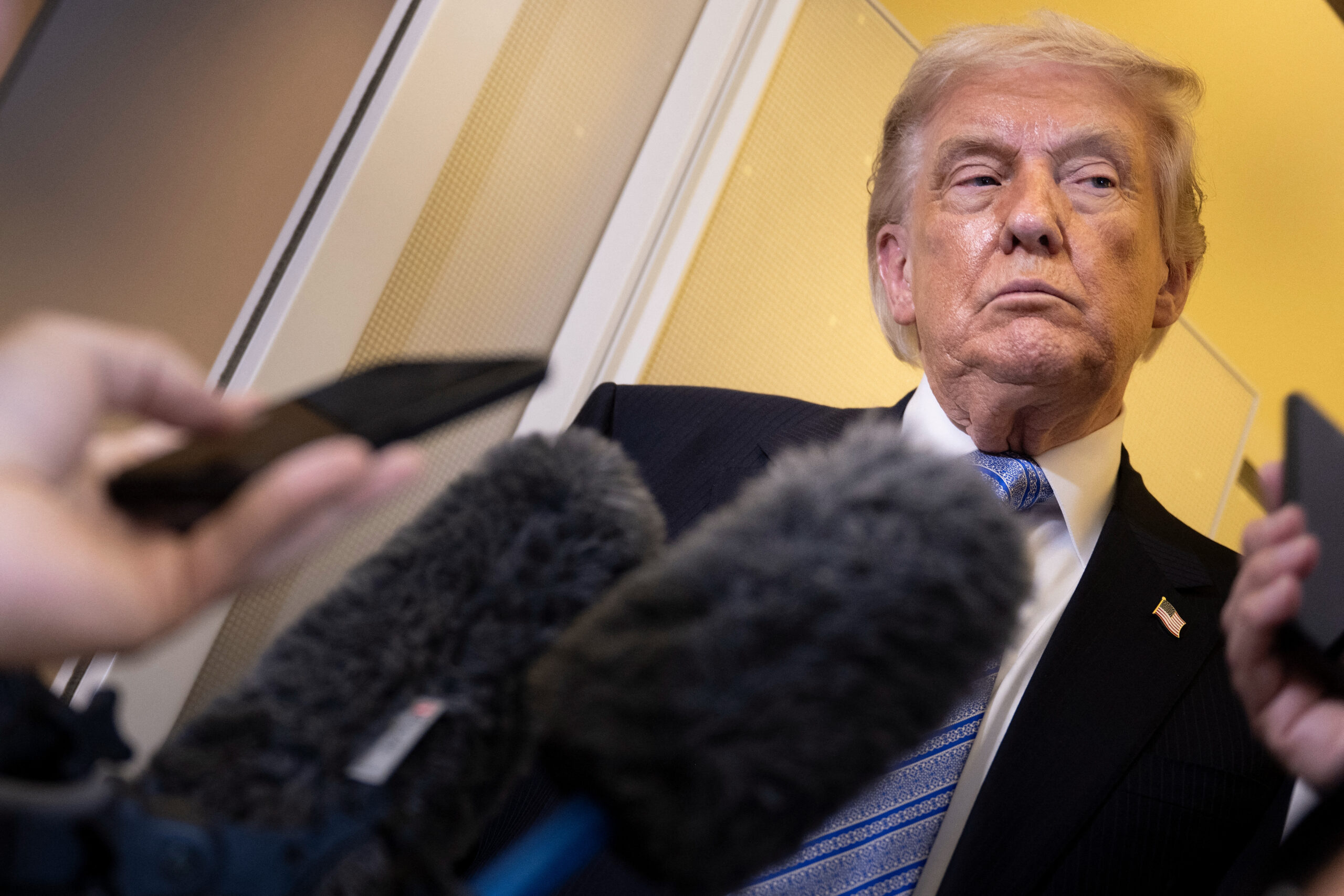
US President Donald Trump speaks to reporters aboard Air Force One after his departure from Beijing Capital Airport on May 15, 2026, on his way back to the United States. Trump said he had made "fantastic trade deals" with China's Xi Jinping, as the pair met on May 15 at final talks of a superpower summit that according to the US leader has also reaped a Chinese offer to help open the Strait of Hormuz. (Photo by Brendan Smialowski / AFP)
May 16, 2026 | Burma Independent Voice
Taiwan responded firmly on Saturday, hours after U.S. President Donald Trump warned Taipei against making a formal declaration of independence, asserting that the island is already an “independent and sovereign country.”
The diplomatic friction follows President Trump’s conclusion of his visit to Beijing on Friday, during which Chinese President Xi Jinping pressured him to halt support for Taiwan. Beijing has long claimed the democratically governed island as an inalienable part of its territory.
In a strongly worded statement, Taiwan’s Ministry of Foreign Affairs declared, “Taiwan is an independent and sovereign democratic country and is not subordinate to the People’s Republic of China.” The ministry further emphasized that U.S. arms sales to Taipei remain an integral component of Washington’s long-standing security commitments to the island.
The response was triggered by Trump’s recent interview with Fox News, where he addressed the cross-strait situation. “I don’t want to see anyone declaring new independence,” Trump said. “I’m not looking to go 9,500 miles away to fight a war, you know. I want to keep things calm. If things stay as they are, I think China can live with it.”
Taiwanese President Lai Ching-te has consistently maintained that Taiwan is already an independent state, making a formal declaration of independence unnecessary. However, concerns are mounting in Taipei as Trump had signaled before his trip to China that he intended to discuss U.S. weapons sales with Xi, hinting at a potential shift away from traditional Washington policy. The development comes shortly after Taiwan’s legislature approved a $25 billion defense spending bill aimed at acquiring advanced U.S. military hardware.
Adopting a more diplomatic tone, Taiwan’s Presidential Office spokesperson Karen Kuo remarked, “The cooperation between Taiwan and the United States has always been demonstrated through concrete actions. We look forward to continuing our partnership with the U.S. backed by the firm commitments enshrined in the Taiwan Relations Act.”
About the Author