
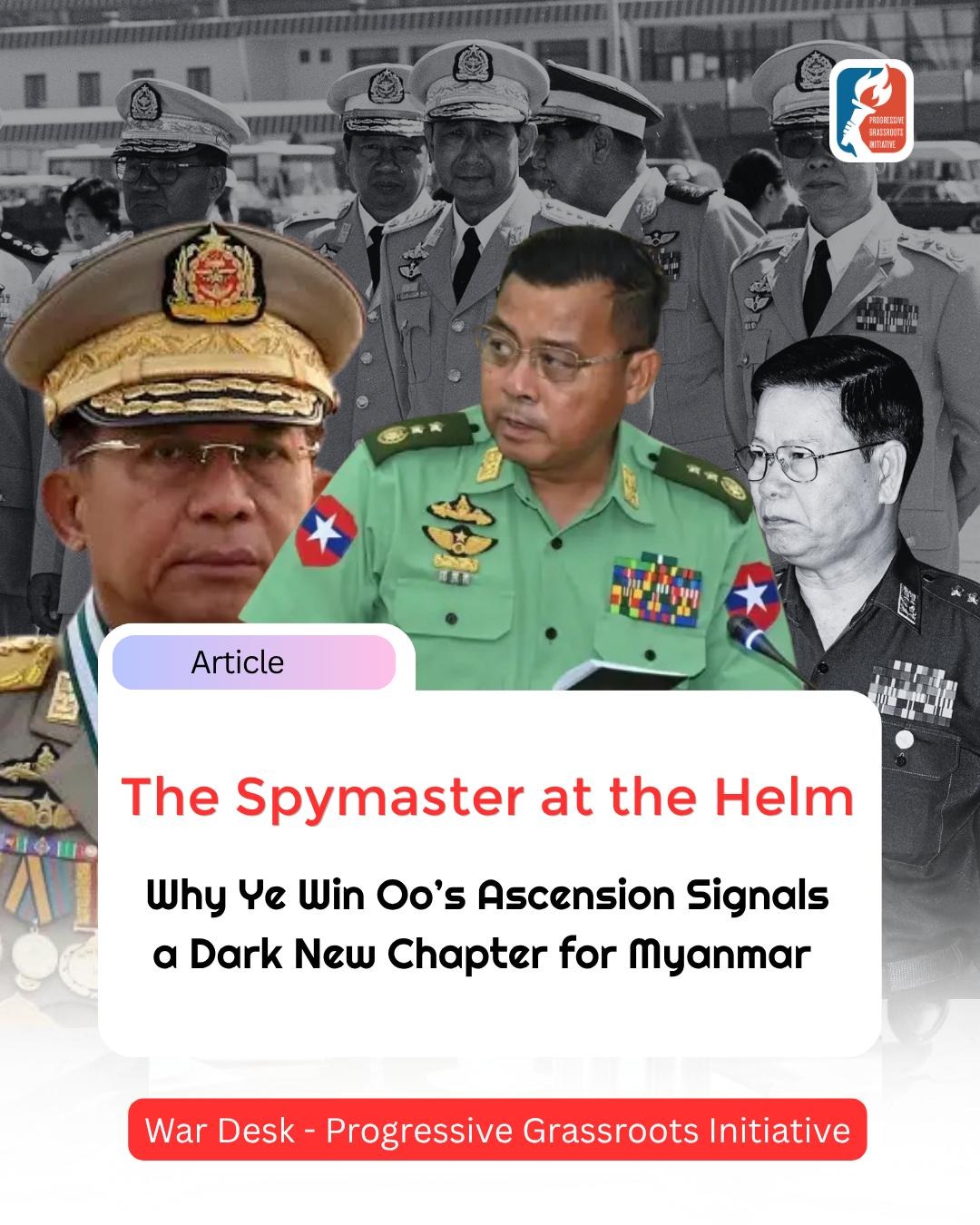
The rise of a military intelligence chief to the top of the Myanmar Military may signal a shift toward a more surveillance-driven model of authoritarian rule.
A Break from Historical Pattern
The reported transfer of Commander-in-Chief authority from Min Aung Hlaing to General Ye Win Oo may seem like an internal reshuffle within Myanmar’s military leadership. However, it actually indicates a deeper institutional change—one that could transform how power is wielded in the country. For the first time in Myanmar’s modern history, a figure with roots in military intelligence appears set to lead the armed forces, raising significant questions about the future path of repression, governance, and state control.
Historically, Myanmar’s military rulers have regarded intelligence services with caution. Under General Ne Win, Military Intelligence chief Tin Oo was dismissed when his influence became too powerful. Decades later, Senior General Than Shwe dismantled the influential intelligence network led by Khin Nyunt, wary of its political influence. These events demonstrated a consistent pattern: intelligence agencies were vital tools of control but also posed potential threats to central authority. Therefore, they were deliberately limited, broken into parts, and kept subordinate to the military command.
From Intelligence Support to Command Authority
The apparent rise of Ye Win Oo indicates a shift from this pattern. Instead of keeping the intelligence apparatus separate, the current leadership might be integrating it more directly into the main command structure. This is important not just because of who is in power but also because of how decisions are made.
Intelligence agencies have traditionally acted as gatherers and processors of information, with multiple filtering layers through analysis before reaching top leadership. When these layers are reduced, the gap between information and action diminishes considerably. The outcome is not only quicker decision-making but also a system where intelligence assessments may lead more directly to coercive action.
Comparative research on authoritarian systems indicates that when intelligence agencies gain increased autonomy or direct political power, patterns of repression can change. Instead of relying mainly on widespread, reactive force, regimes may progressively adopt more precise, pre-emptive methods of control. This does not necessarily lessen repression; rather, it can make it more systematic and difficult to detect, as surveillance and coercion become more closely intertwined.
Beyond Personal Rivalries
While the promotions of Ye Win Oo and other senior figures have been presented as the elevation of trusted loyalists, the transition might indicate more than a routine consolidation of power within the military hierarchy.
Speculation about internal rivalries—especially surrounding Vice Senior General Soe Win—risks obscuring the broader institutional shift taking place. The main issue is not which individual succeeds, but how the balance between command authority and intelligence capability is developing. The seeming consolidation of these functions indicates a recalibration of the regime’s approach to survival.
Data, Surveillance, and Coercion
In Myanmar’s current situation, this change could have immediate effects. The military’s ongoing efforts to enforce conscription, for instance, may become more effective under a system that focuses on intelligence collection and population oversight. Identifying, tracking, and pressuring individuals requires not only coercive ability but also detailed information networks—something an intelligence-driven structure is better equipped to supply.
Simultaneously, the regime has been expanding centralised data systems, including national identification initiatives and digital registration mechanisms. While such systems are often presented in administrative terms, they also carry significant political implications. Greater data integration can improve the state’s ability to monitor citizens’ movements, economic activities, and social networks. If closely connected to security institutions, these tools could enable more precise forms of control over both individuals and communities.
Extending Control Beyond Borders
The implications go beyond Myanmar’s borders. For the country’s large diaspora and migrant population, enhanced integration of intelligence and data systems increases the risk of indirect pressure. Family members remaining in Myanmar, financial flows such as remittances, and access to official documents can all become points of leverage.
While the extent of such practices remains uncertain, experiences from other contexts suggest that intelligence-driven regimes often aim to expand their reach across borders, especially when they encounter sustained domestic opposition.
External Support and Technical Capacity
External partnerships may further influence this trajectory. Myanmar’s military has sustained security and diplomatic relations with countries such as China, India, and Russia, including high-level visits involving senior defence officials. Notably, both Ye Win Oo and Vice Commander-in-Chief Kyaw Swar Lin were part of Min Aung Hlaing’s delegations to China and Russia, while Chief of General Staff Ko Ko Oo made multiple visits to India in 2025, during the period leading up to the planned elections.
These patterns indicate that the current leadership transition is not happening in isolation, but alongside efforts to position a new generation of senior officers within existing military-to-military networks. Although the full implications remain unclear, such continuity could play an important role in maintaining external security cooperation, including areas related to training, technology, and intelligence exchange.
Conclusion
While often seen as the consolidation of trusted figures within Min Aung Hlaing’s inner circle, the reported leadership change may also indicate a deeper transformation in the way authoritarian power is organised in Myanmar—one that warrants closer examination, both domestically and internationally.
Myanmar’s crisis is frequently described as a stalled democratic transition or ongoing armed conflict. Both remain key aspects. However, the potential shift towards a more intelligence-led model of governance indicates a parallel transformation—one where control is exercised not only through visible force but also increasingly through the management of information.
For policymakers and observers alike, this shift matters. It indicates that the future of authoritarian governance in Myanmar may rely not only on military strength but also on the regime’s increasing ability to monitor, predict, and control society through intelligence, data, and international engagement.
About the Author