
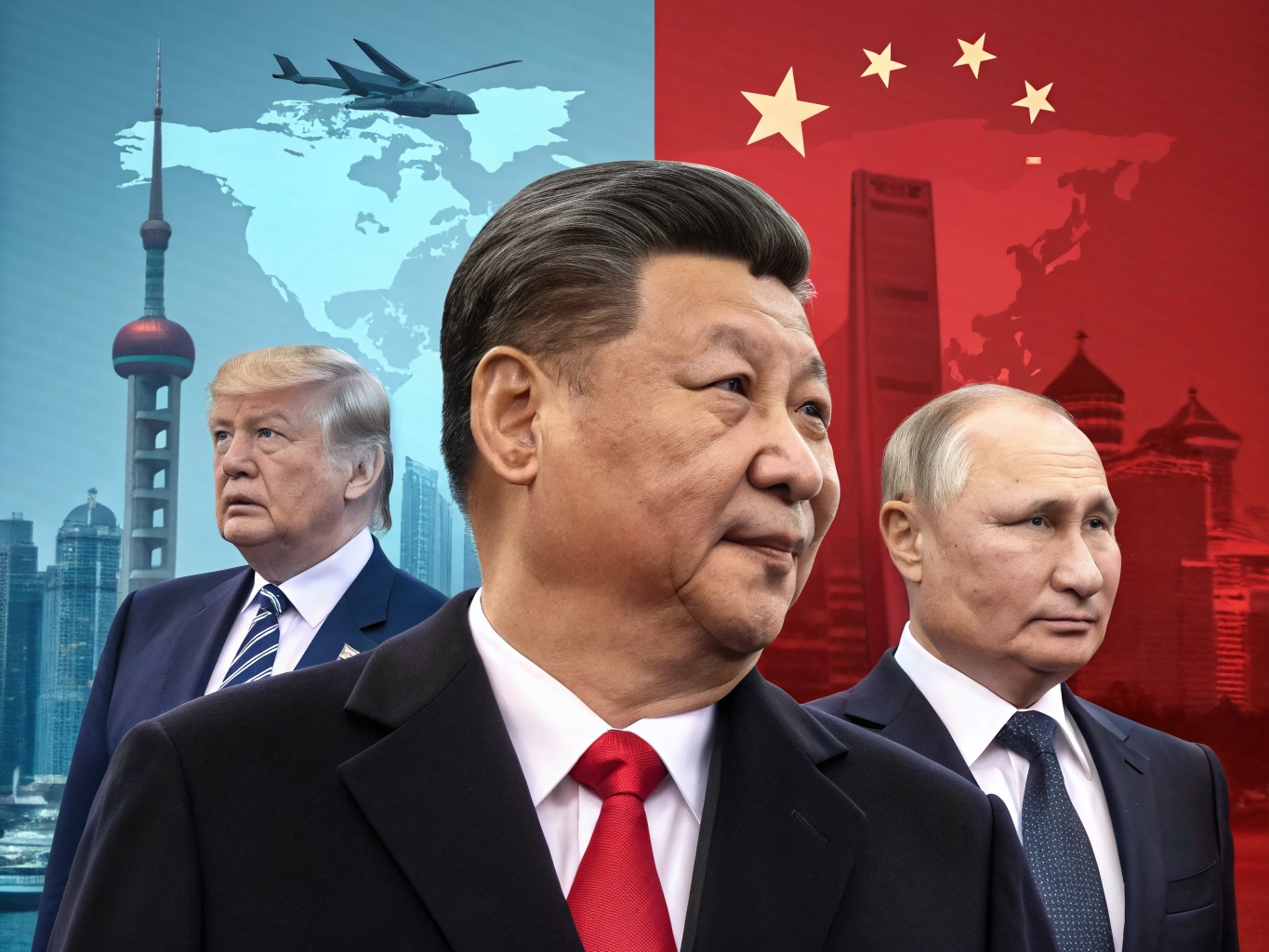
BEIJING — A defining geopolitical shift has reshaped the global map of power dynamics as Chinese President Xi Jinping hosted two of the world’s most powerful leaders—U.S. President Donald Trump and Russian President Vladimir Putin—in quick succession in Beijing.
At first glance, these meetings could be viewed as routine diplomatic summits. However, the optics and substance of these back-to-back visits fundamentally disrupt decades of established global power distribution. For generations, Washington sat at the axis of international politics, Moscow commanded raw military might, and Beijing operated as a rising economic force. Today, the landscape has inverted: both Trump and Putin found themselves traveling to Beijing, positioning Xi Jinping at the center, deftly navigating relations with both nations.
The Trump Visit: Transactional Diplomacy and Stalemate
The Beijing itinerary of U.S. President Donald Trump underscored an approach driven by economic pragmatism and transactional leverage rather than long-term geopolitical realignment. Discussions centered heavily on bilateral trade, pushing China to increase purchases of American agricultural goods, easing technology restrictions, and negotiating major Boeing aircraft deals.
Nevertheless, intense and friction-filled debates emerged over critical bottlenecks. These included U.S. restrictions on high-tech semiconductor chips vital to China’s tech sector, the Taiwan strait issue, and Beijing’s stringent export controls on global rare earth elements.
In hosting Trump, China prominently emphasized the narrative of being “economic partners.” The underlying message directed at Washington was clear: While we remain strategic rivals, we are economically interdependent and cannot easily decouple.
Yet, the summit yielded no breakthroughs regarding core systemic crises—namely Washington’s strategic containment policies, the tech war, and military posturing in the Indo-Pacific. Political analysts have characterized the meeting as a “deadlock summit,” noting it did not resolve deep-seated animosities but merely succeeded in keeping tensions from boiling over into open conflict.
The Putin Visit: An Alliance Against Western Hegemony
Shortly after President Trump’s departure from Beijing, Russian President Vladimir Putin arrived, shifting the diplomatic tone from transactional bargaining to an overt challenge against Western hegemony.
Xi and Putin focused their agenda on dismantling the U.S.-led unipolar world order. The two leaders aligned on countering Western dominance, jointly opposing NATO’s eastward expansion, and framing economic sanctions as a shared threat to be collectively resisted.
However, the current geopolitical reality dictates that Russia has become increasingly dependent on China following severe Western sanctions over the Ukraine war. Moscow relies heavily on Beijing as a vital economic and strategic lifeline—serving as a sustained market for Russian oil, a critical supply chain for electronics and semiconductor chips, an alternative banking payment infrastructure, and a key partner for future Artificial Intelligence (AI) development. Consequently, despite Putin’s rhetoric of a “strategic partnership of equals,” the balance of power heavily favors Beijing, which retains firm control over the terms of engagement.
This power asymmetry is visibly evident in the ongoing negotiations for the “Power of Siberia 2” natural gas pipeline. For Russia, having lost its European consumer base, this project is an economic artery. Beijing, recognizing its leverage, has shown no urgency—deliberately stalling to extract deeper price concessions and renegotiate contractual terms. While Russia remains a formidable military power, economically it increasingly operates within China’s sphere of influence.
Concurrently, Beijing and Moscow have integrated the issues of Taiwan and Ukraine into a unified narrative. China frames the Taiwan issue as a consequence of Washington’s encirclement and containment strategy, while Russia depicts the Ukraine conflict as an inevitable reaction to NATO’s eastward overreach, thereby institutionalizing their strategic cooperation against the U.S.-led system.
Beijing as the New Geopolitical Axis
As the dust settles on both high-stakes summits, the definitive winner emerges as Chinese President Xi Jinping. Beijing has effectively consolidated its status as the geopolitical gravity center, where the leaders of two rival superpowers must travel to secure their own national and political interests. Xi has demonstrated to the global community that decoupling from or isolating China is no longer a viable option for any global bloc.
During the Cold War era, nations were forced to choose between Washington and Moscow. In today’s complex global arena, China has successfully positioned itself as the central “Balancing Center” between the United States and Russia, firmly occupying the anchor position on the world stage and actively reshaping the contours of a new international order.
About the Author