
May 20, 2026 | Burma Independent Voice
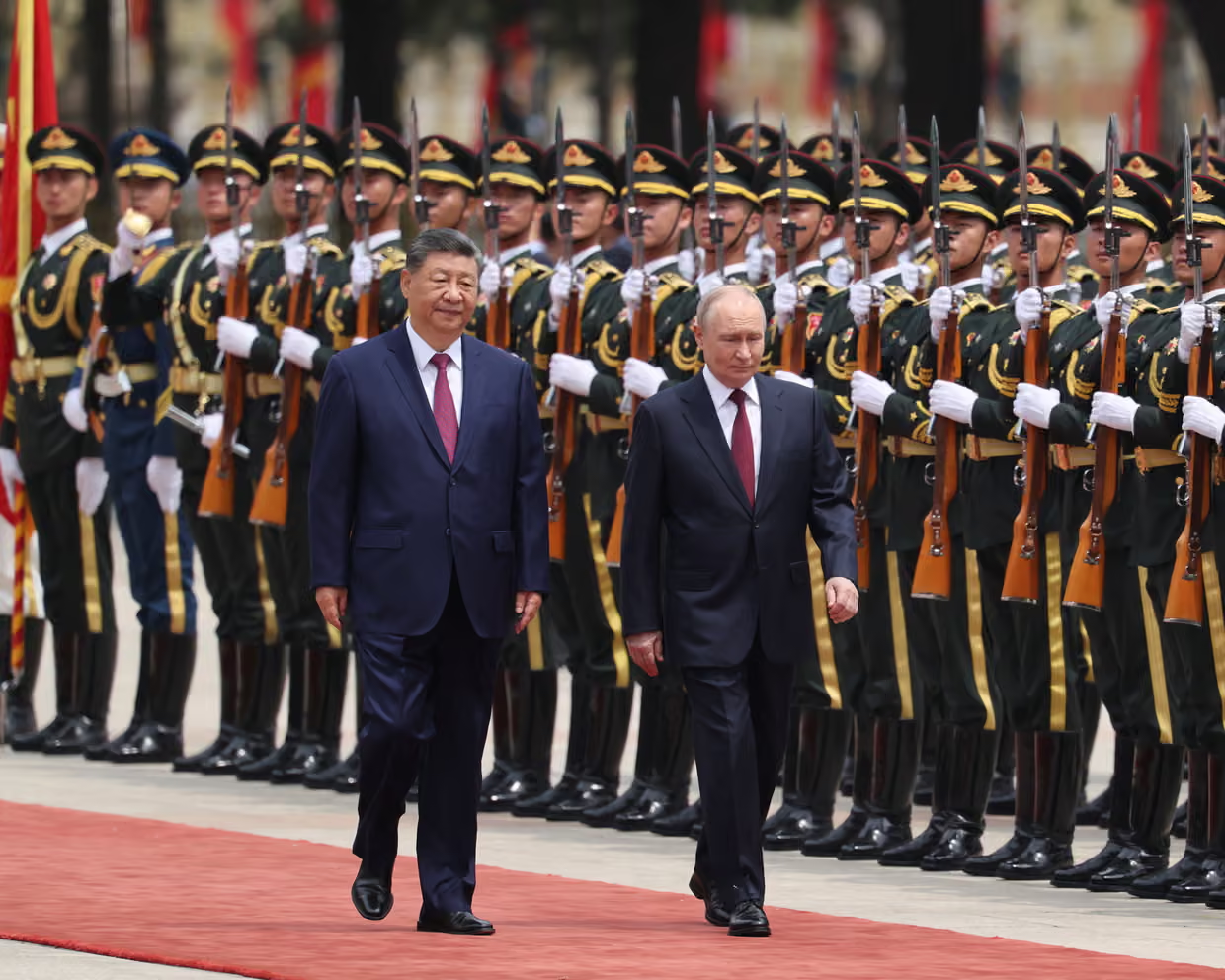
Less than a week after U.S. President Donald Trump concluded his official visit to China, Chinese President Xi Jinping hosted Russian President Vladimir Putin with full military honors and ceremonial bands at the Great Hall of the People in Beijing on Wednesday morning to initiate bilateral talks.
The international community is closely monitoring the meeting, which follows high-level discussions held at the same venue last week between President Trump and President Xi regarding bilateral trade, foreign investment, the Iranian conflict, and cross-strait relations.
The two leaders initially held a restricted-attendance “small-group session” to deliberate on highly sensitive geopolitical matters before transitioning into an expanded, plenary assembly that concluded at 2:00 PM. Following the summit, the two nations signed a series of pacts spanning technology transfer, bilateral trade, scientific research, and intellectual property protection. They also formally renewed the landmark 25-year-old “Sino-Russian Treaty of Good-Neighborliness and Friendly Cooperation.”
President Xi Jinping declared that Sino-Russian relations have reached the “highest level of a comprehensive strategic partnership,” and called for joint resistance against “unilateral hegemony” on the global stage.
Warning that the international community must not be allowed to revert to the “law of the jungle,” Xi emphasized the urgent need for a ceasefire in the Middle East. President Putin reaffirmed that Russia remains a “reliable energy supplier” to China and extended an official invitation to Xi to visit Russia next year.
Despite ongoing friction between Beijing and Western nations, Xi and Putin consistently referred to each other as “old friends” throughout the summit. During their exchanges, Putin cited a classic Chinese proverb, noting that “a single day apart feels like three autumns.” In return, Xi arranged an informal, open-collar tea reception for Putin at the Zhongnanhai compound, the headquarters of the Chinese Communist Party.
Bilateral trade with China has served as a critical economic lifeline for Moscow amidst sweeping international sanctions triggered by the war in Ukraine. China remains Russia’s largest commercial partner, consuming nearly half of total Russian crude oil exports.
Kremlin spokesperson Dmitry Peskov indicated that a potential bilateral meeting between President Putin and U.S. President Donald Trump is being considered on the sidelines of the upcoming APEC Summit, scheduled to take place in China this November.
Concurrently, the Chinese Ministry of Commerce officially confirmed its intention to finalize the purchase of 200 Boeing aircraft from the United States, while signaling its commitment to extending the U.S.-China trade framework established last year in Kuala Lumpur. The announcement marks Beijing’s first formal confirmation of the aerospace orders previously highlighted by Trump last week.
About the Author