
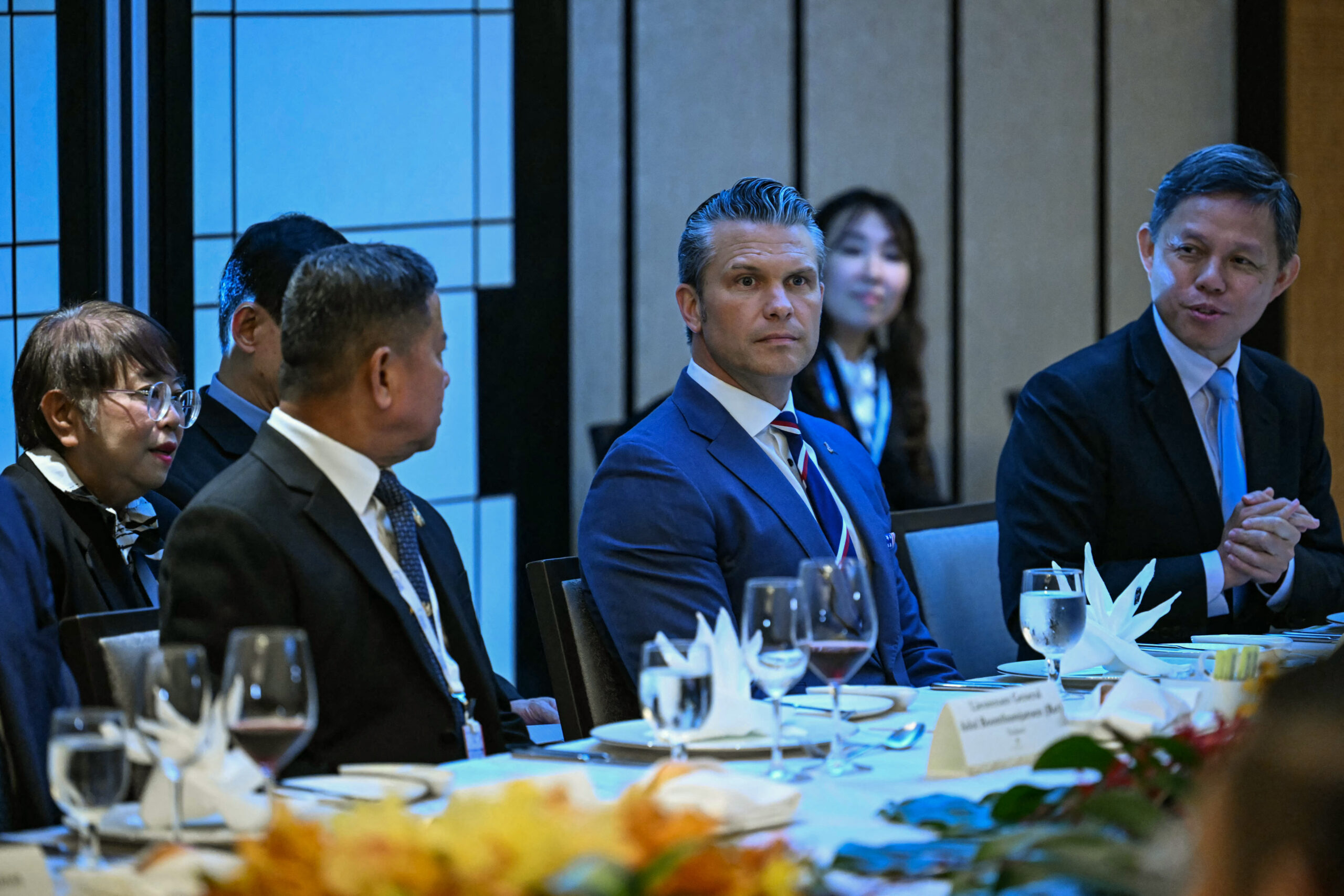
US Secretary of Defence Pete Hegseth (C), Thailand's Defence Minister Adul Boonthamcharoen (L), and Singapore's Minister of Defence Chan Chun Sing attend a ministerial roundtable during the 23rd Shangri-La Dialogue summit in Singapore on May 30, 2026. (Photo by MOHD RASFAN / AFP)
May 30, 2026 | Burma Independent Voice
U.S. Defense Secretary Pete Hegseth renewed his sharp criticism of NATO and European allies on Saturday, warning that countries failing to sufficiently increase their defense spending will face “significant changes in how the United States operates.”
NATO member states pledged last year to boost their defense expenditures to 5% of their gross domestic product (GDP). However, despite ongoing efforts, numerous nations are now declaring that meeting this ambitious target is practically impossible.
“Polite requests for European allies to spend more on their own defense have been ignored for a very long time,” the Pentagon chief stated during a security summit in Singapore.
Delivering a speech at the annual Shangri-La Dialogue, Hegseth remarked, “Now, they are playing catch-up.”
“Allies who refuse to bear responsibility for our collective defense will see significant changes in how we operate.”
Earlier this month, U.S. Secretary of State Marco Rubio also noted that Washington is facing a shifting reality, where the U.S. military footprint within NATO in Europe may have to be scaled back as European nations step up their own defense capabilities, allowing the U.S. to focus on other global threats.
Turning his attention to Asia, Hegseth reiterated that security in the region has remained “disproportionately dependent on U.S. military power, while too many of our allies and partners have allowed their own defense capabilities to atrophy.”
However, Hegseth acknowledged that several nations in the Asia-Pacific region are currently stepping up their efforts, singling out South Korea as a prime example.
“South Korea has consistently invested in its own defense. That is because they do not have the luxury of treating war as a textbook exercise. Living on the front lines, they have built real combat capability.”
He emphasized that such initiatives “simply reflect a clear-eyed understanding of the threat environment.”
Furthermore, Hegseth praised the spending policies and defense commitments of other regional nations, including Australia, the Philippines, and Japan.
“You cannot have a strong alliance unless everyone has skin in the game. There are no free rides,” Hegseth asserted.
When a New Zealand delegate questioned whether the island nation’s plan to raise its defense spending from 1% to 2% of GDP was considered a “free ride,” Hegseth agreed with the assessment.
“Frankly, 2% is not enough, so 2% is a free ride. I bear no malice toward New Zealand, but I want partners to do more,” Hegseth responded.
About the Author