
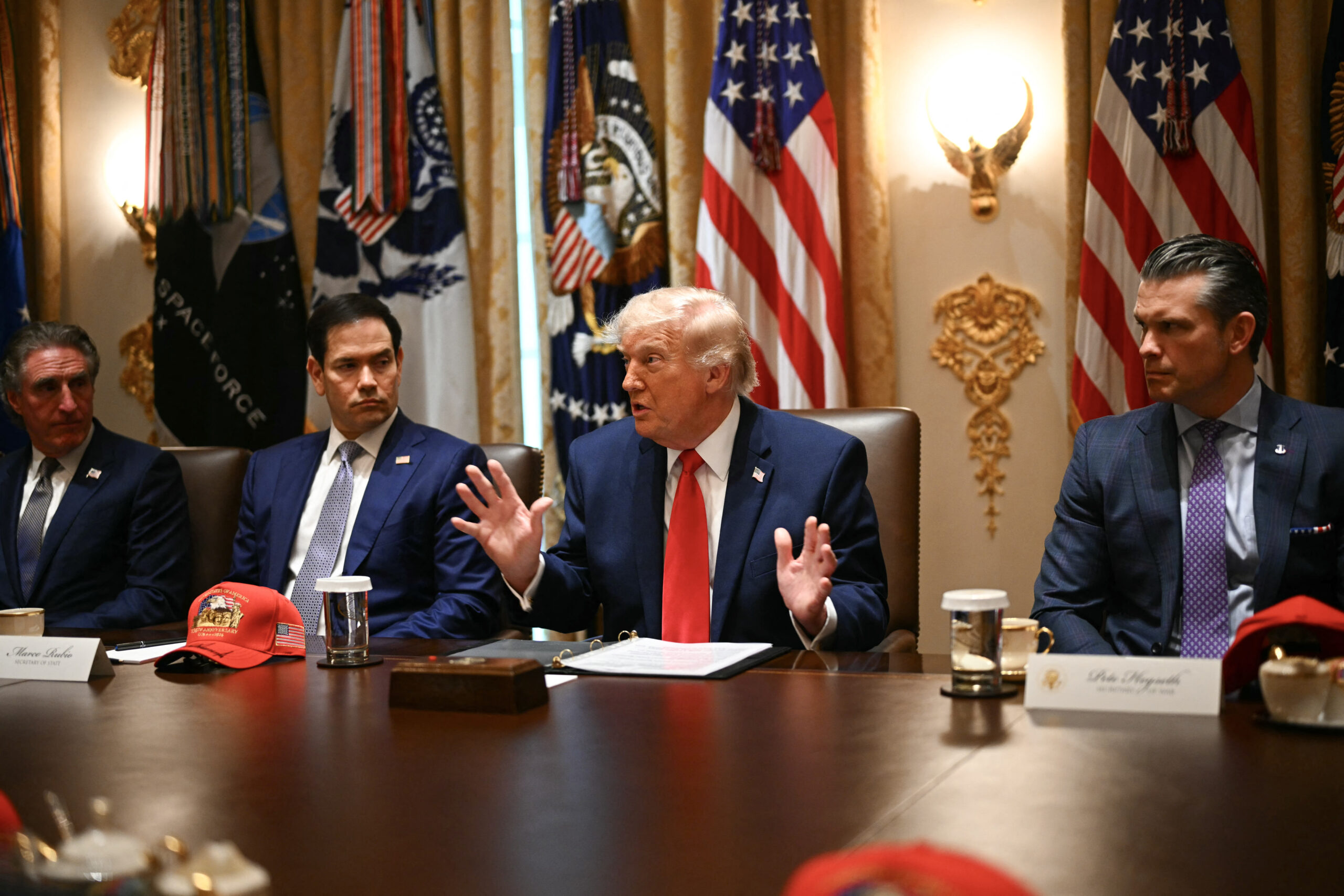
US Secretary of the Interior Doug Burgum (L), US Secretary of State Marco Rubio (2nd L) and US Defense Secretary Pete Hegseth (R) listen to US President Donald Trump speak during a cabinet meeting in the Cabinet Room of the White House in Washington, DC, on May 27, 2026. (Photo by Kent NISHIMURA / AFP)
May 31, 2026 | Burma Independent Voice
U.S. President Donald Trump announced that Iran has given him assurances that it will not develop nuclear weapons. However, reports have simultaneously emerged that Washington has transmitted a more stringent, revised peace proposal back to Beijing and Tehran.
This sudden restructuring of the framework could trigger multi-week delays in finalizing the highly anticipated accord aimed at formally ending the Middle East war and reopening the blockaded Strait of Hormuz shipping lanes.
Reports published on Saturday by The New York Times and Axios indicate that Trump has sent back a newly modified framework containing much tougher conditions for Iran to consider, though specific clauses of the text remain classified.
Trump has consistently reiterated that his absolute priorities in any final text are permanently halting Iran’s nuclear weapon ambitions and fully reopening the strategic Strait of Hormuz.
“One thing I must have as a guarantee is absolutely no nuclear weapons (for Iran). And they have already agreed to that, which is very interesting,” Trump said during an interview with his daughter-in-law, Lara Trump, broadcast Saturday evening on Fox News.
However, Tehran has previously expressed deep skepticism toward Trump’s public statements, and the core priorities of both administrations remain sharply polarized.
According to Iranian state-affiliated media, Tehran insists that the U.S. must first repatriate $12 billion in frozen Iranian assets before any substantive negotiations on core issues, like its nuclear program, can commence. Iranian officials also dismissed Trump’s demands regarding the destruction of their enriched uranium stockpiles—the precursor to nuclear weapons—as “baseless.”
Furthermore, Tehran maintains that any finalized deal to end the war must comprehensively include Lebanon, despite ongoing hostilities.
Concurrently, the government in Beirut has accused the Israeli military of implementing a “scorched-earth policy” through its escalating troop deployment and relentless airstrikes inside Lebanese territory, which Israel claims are targeting Iran-backed Hezbollah assets.
While Trump and senior U.S. officials initially characterized a final agreement as being within arm’s reach, Trump adopted a more measured, patient tone during his Fox interview, while subtly hinting at potential military alternatives.
“I’m in no rush,” Trump asserted. “Slowly but surely, we are getting what we want. If we don’t get what we want, it’s going to end up another way,” he warned.
This warning directly mirrors statements made Saturday by Pentagon Chief Pete Hegseth at an Asian defense summit, where he declared that Washington maintains “more than enough capability” to resume full-scale warfare if diplomatic tracks fail.
Following the historic April talks hosted by Pakistan between Tehran and Washington, a temporary ceasefire agreement successfully halted daily bombardments inside Iran and the wider Gulf region, though low-level armed skirmishes have persisted.
Iran’s state-run broadcaster IRIB reported that the Islamic Revolutionary Guard Corps (IRGC) successfully downed a U.S. military drone that was reportedly attempting to execute “hostile operations inside Iranian territorial waters.” Washington has not yet confirmed the incident.
Earlier this week, the most severe breach of the fragile ceasefire occurred when the U.S. military launched strikes against the Iranian port city of Bandar Abbas, triggering immediate retaliatory fire from Iranian forces.
Despite the volatility, Trump remains diplomatically engaged to secure an agreement capable of lifting the blockade on the Strait of Hormuz, which continues to choke global oil supplies and threaten the international economy and commodity prices.
Trump claimed on social media that under the proposed terms, Iran would waive its right to collect transit fees from commercial vessels traversing the strait once sanctions are lifted. However, the Iranian Fars News Agency swiftly countered, stating that “no such provision exists within the negotiated text.” On Saturday, Iran’s ISNA News Agency quoted Iranian lawmaker Alireza Salimi as stating that “parliament will soon ratify Iran’s sovereignty and management plan over the Strait of Hormuz.”
Meanwhile, on Saturday, the Israeli military issued fresh evacuation orders to residents in southern Lebanese villages, shortly after Israeli Prime Minister Benjamin Netanyahu confirmed that his ground forces have advanced over 30 kilometers (approximately a 20-minute drive) into Lebanese territory.
Lebanese Prime Minister Nawaf Salam condemned Israel for executing “scorched-earth tactics and collective punishment,” demanding a swift and genuine ceasefire.
However, the Israeli military confirmed in a statement early Sunday morning that it is expanding its ground incursions. The military stated that “significant combat elements” have crossed the Litani River to expand offensives against Hezbollah positions in the Beaufort Castle and Wadi Al-Saluki sectors.
Although a ceasefire between Israel and Hezbollah was theoretically initiated on April 17, it was never fully realized as both sides continuously traded accusations of systematic violations.
The broader conflict escalated in early March when Iran-backed Hezbollah launched a massive missile barrage at Israel in retaliation for a joint U.S.-Israeli strike that killed Iran’s top leader. This triggered daily Israeli airstrikes and a subsequent ground invasion into Lebanon. Direct negotiations between Israel and Lebanon commenced in April, with a fourth round of high-level talks anticipated to take place next week.
About the Author