


Analysis | Burma Independent Voice
By Wai Ya Mone
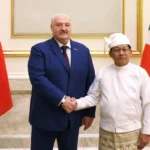
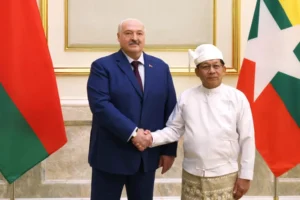
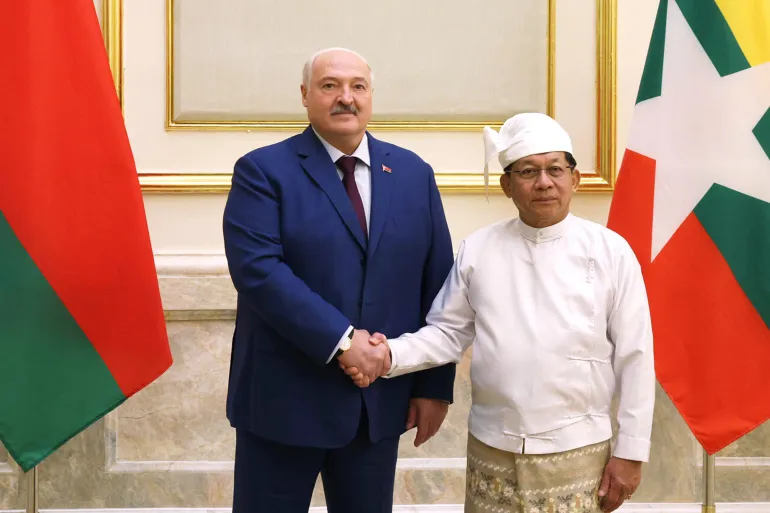
Belarusian President Alexander Lukashenko is reportedly scheduled to undertake a high-level working visit to Naypyitaw in the near future. Having previously visited Naypyitaw in November 2025, this upcoming 2026 trip will mark his second official visit. While analyses of Naypyitaw’s political and diplomatic maneuvers typically emphasize the strategic importance of China, Russia, and regional neighbors, Belarus has long been dismissed as a distant nation with negligible impact on Myanmar’s political landscape.
However, the political trajectory and resilience of Belarus could serve as an exemplary model of authoritarianism for Myanmar. Geographically situated in Eastern Europe, Belarus is frequently labeled in modern geopolitics as “Europe’s last dictatorship.” It remains a highly centralized state that has systematically resisted and countered the democratic norms of its European neighbors for over three decades.
Following its independence in 1991, Belarus initially embarked on political and economic reforms, earning it a “partly free” designation from international watchdogs. However, the political landscape shifted dramatically following Lukashenko’s election to the presidency in 1994. Under his administration, power was rapidly centralized, independent institutions were dismantled, and the state security apparatus was aggressively expanded to exert total control over citizens and civil society.
While neighboring states sought integration into the European Union (EU), Belarus chose a path of absolute resistance against Western influence. This pivot created a profound geopolitical rift, leaving Minsk today as one of the few European capitals without formal treaty relations with the EU.
For decades, the West deployed a traditional “carrot and stick” strategy to alter Belarus’s authoritarian course. The EU, in particular, enacted stringent sanctions, travel bans on perpetrators, and economic penalties to penalize human rights violations, while simultaneously offering trade incentives, visa relaxations, and scholarships for Belarusian students to encourage democratic reforms.
Nevertheless, such European pressure failed to catalyze domestic transformation; instead, it solidified the Belarusian regime’s resilience. Crucially, the country’s economic system remained un-reformed and heavily state-controlled, leaving the ruling elite entirely dependent on the president for their wealth and positions. Recognizing that the preservation of power yielded far greater privileges than conforming to Western-backed democratic systems, the ruling class chose to reject democratic reforms and sustain Lukashenko’s grip on power.
Furthermore, Western economic isolation did not compel Belarus to embrace democracy; rather, it served as a catalyst for deeper alignment with the strategic interests of China and Russia. Following Belarus’s highly disputed 2020 election, severe Western sanctions on Minsk positioned Russia as a vital financial lifeline, providing critical energy supplies and logistical assistance. By 2022, Russia’s invasion of Ukraine severed Belarus’s ties with Ukraine, its second largest market rendering.Moscow Minsk’s most indispensable economic partner. Consequently, Belarus integrated fully into Russia’s economic sphere, leveraging Russian logistical and banking frameworks to forge commercial ties with China and fellow member states of the Eurasian Economic Union.
Thus, despite being barred from European markets, Belarus successfully withstood Western alienation by building alliances grounded in diplomatic and economic reciprocity with alternative strategic partners. It is precisely this factor that renders Belarus an exemplary blueprint for Naypyitaw, which currently faces its own barrage of Western sanctions. Relations between Belarus and Myanmar remain robust, underpinned by mutual economic benefits, customs agreements, and military-technical cooperation. Lukashenko’s upcoming visit serves as a clear manifestation of deepening diplomatic ties and reciprocal economic collaboration.
In conclusion, Belarus highlights the adaptability and survival capacity of modern authoritarianism, proving that Western punitive measures and sanctions are often insufficient to collapse autocratic regimes. Observing the Belarusian model suggests that Western economic blockades and sanctions against Myanmar may simply be obsolete, conventional strategies. In reality, the overriding influence of China, Russia, and select regional powers on Myanmar’s contemporary politics remains undeniable.
The author, Wai Ya Mone , is a political, conflict, and security analyst.