
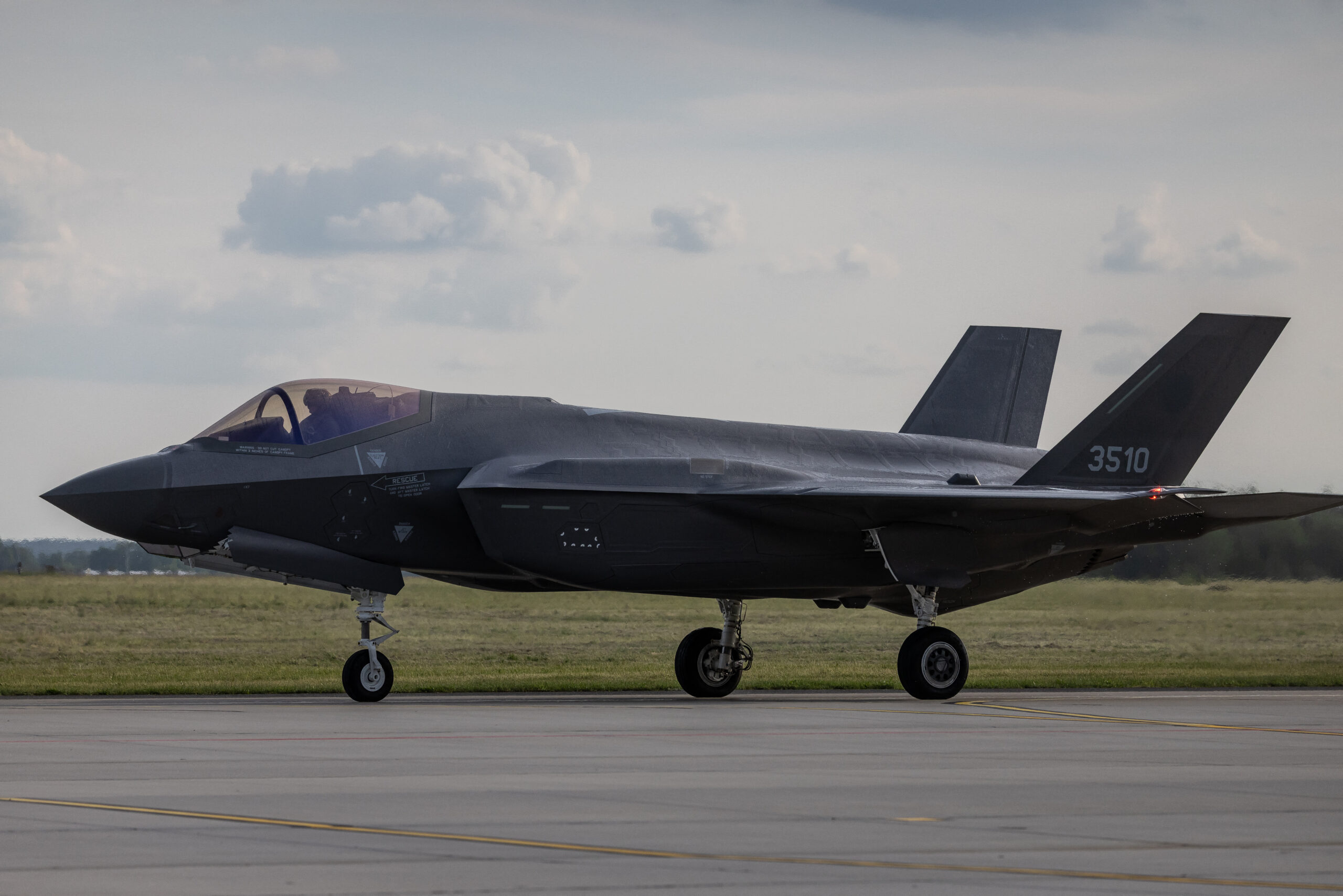
One of the first of three US-made F-35 aircraft in Polish Air Force colours taxis along the runway at the 32nd Tactical Air Base in Lask, central Poland, on May 22, 2026. (Photo by Wojtek RADWANSKI / AFP)
May 26, 2026 | Burma Independent Voice
The United States military has launched fresh airstrikes targeting Iranian missile positions and vessels attempting to deploy naval mines in southern Iran.
U.S. Central Command (CENTCOM) described the operations as “self-defense” measures strictly intended to “protect our service members from imminent threats posed by Iranian forces.”
CENTCOM spokesperson Captain Tim Hawkins clarified that during the ongoing ceasefire between the two nations, the U.S. military intends to maintain “measured and disciplined actions to protect our forces without escalating the conflict.”
Iran has not yet launched any immediate military retaliation in response to the latest American strikes. However, Iranian Foreign Ministry spokesperson Esmail Baqai stated earlier that despite some tangible progress in the peace talks, it remains premature to conclude that a final accord is imminent.
The long-term impact of these latest strikes on the potential peace treaty between Washington and Tehran remains highly uncertain.
Despite the military flare-up, U.S. Secretary of State Marco Rubio maintained that a diplomatic breakthrough is still entirely achievable. He pointed to scheduled high-level talks on Tuesday involving Iran’s chief negotiator, the Iranian Foreign Minister, and the Prime Minister of Qatar.
Speaking to reporters during his official diplomatic visit to India, Secretary Rubio said, “We will have to wait and see if we can sustain this momentum. I suspect it will take a few more days because there are still substantial disagreements regarding the specific legal terminology inside the preliminary text.” Rubio also emphasized that President Donald Trump remains determined to secure a final resolution.
“When he (Trump) makes a deal, it has to be the best possible deal, or there won’t be a deal at all,” Rubio added.
When pressed by journalists regarding Monday’s airstrikes, Rubio responded firmly: “The Strait of Hormuz must remain open. One way or another, they (Iran) will have to yield, so it will stay open. What is happening in that region is illegal, illegitimate, unsustainable for the international community, and entirely unacceptable.”
According to a report by The New York Times, Captain Hawkins confirmed that the American strikes targeted an area near the southern port city of Bandar Abbas, a strategic location that overlooks the Strait of Hormuz and serves as a major Iranian naval base. Iranian state-run media previously reported that local authorities were investigating loud explosions heard across Bandar Abbas.
In early May, a tense standoff occurred in the Strait of Hormuz between Iranian and U.S. naval destroyers. While both nations traded blame for the provocation, President Trump insisted at the time that the established ceasefire remained intact and unbroken.
Although President Trump hinted last weekend that both sides were on the verge of a breakthrough, he subsequently adjusted his rhetoric, instructing his negotiating team to “avoid rushing.” Secretary Rubio, however, maintained on Monday that an agreement remains viable.
In response, Iranian spokesperson Baqai countered, “It is true that we have reached a mutual understanding on many of the core issues under discussion. However, whether this means we are close to signing an agreement is something no one can confidently guarantee at this stage.”
The Memorandum of Understanding (MOU) currently under negotiation reportedly includes provisions for a 60-day extension of the ceasefire, the reopening of the Strait of Hormuz, and a framework for subsequent discussions regarding Iran’s nuclear program.
According to CBS News, the U.S. partner of the BBC, American intelligence agencies believe that Iran’s supreme leader, Mojtaba Khamenei, was wounded during the initial Israeli airstrikes on the first day of the war—which claimed the life of his father. Intelligence reports suggest he is currently in hiding at a clandestine location, making communications with his appointed envoys highly difficult and directly contributing to the delays in negotiations with the United States.
According to U.S. media analysts, these high-level talks are unlikely to yield an immediate, all-encompassing resolution. Highly contentious issues—including the lifting of sanctions on Tehran, the repatriation of billions in frozen Iranian assets, and Washington’s demands to permanently curb Iran’s nuclear ambitions—are expected to be deferred for subsequent negotiations.
At the onset of the conflict, Iran was believed to possess roughly 440 kilograms (approximately 970 pounds) of uranium enriched to 60 percent purity. Because this concentration is only a few technical steps away from weapons-grade 90 percent purity, Iran possesses the theoretical capacity to assemble a nuclear weapon.
On Monday evening, President Trump declared that these enriched stockpiles must “immediately” be transferred to U.S. custody or, “preferably, destroyed in a coordinated manner with the Islamic Republic of Iran.”
U.S. and Iranian forces have largely observed a fragile ceasefire since April 8. However, Iran maintains its tight grip over Persian Gulf shipping lanes via the Strait of Hormuz, while the U.S. Navy continues its efforts to enforce a blockade on Iranian ports.
The regional war erupted on February 28 when the U.S. and Israel launched extensive, coordinated airstrikes across Iran. Tehran responded with retaliatory strikes against Israel and Washington’s regional allies in the Gulf, alongside an effective blockade of the Strait of Hormuz that triggered an exponential surge in global oil prices.
About the Author