

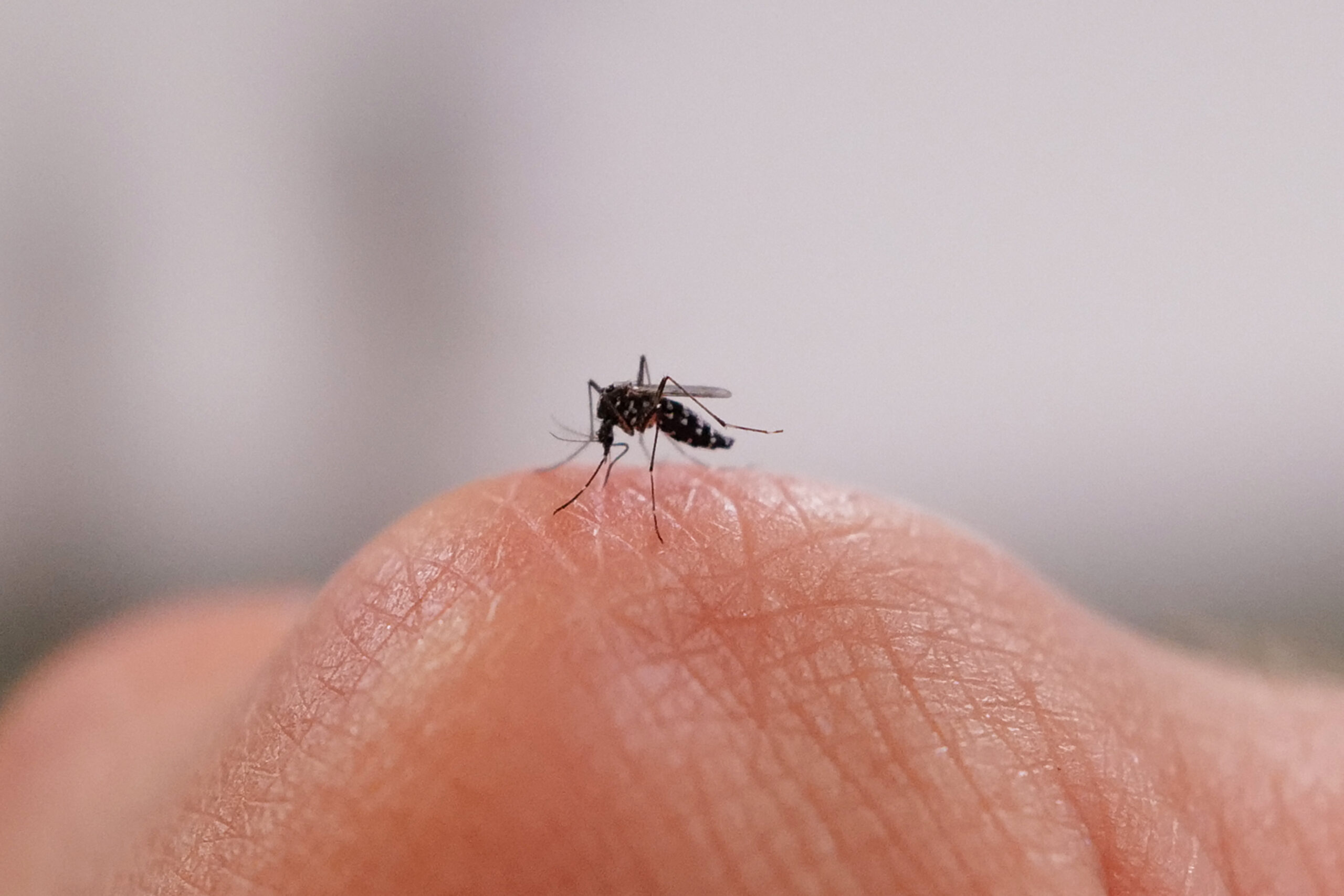
(FILES) A photo shows a female tiger mosquito at the Terratis company facilities in Montpellier, southern France, on June 5, 2026. With global warming, 80% of the worlds population now runs the risk of being exposed to one or more infectious diseases long considered tropical, which cause more than a million deaths a year, mostly among children, according to the World Health Organization (WHO). (Photo by Sylvain THOMAS / AFP)
June 16, 2026 | Burma Independent Voice
Have you ever found yourself being relentlessly bitten by mosquitoes while those around you remain completely untouched? Scientists have now delved deeper into understanding the exact chemical cocktail that attracts these disease-carrying bloodsuckers to certain individuals over others.
“It is not a myth; mosquitoes genuinely find some individuals more attractive than others,” Frédéric Simard, a medical entomologist at the French National Research Institute for Sustainable Development (IRD), told AFP. “However, none of us are targeted by mosquitoes all the time.”
Mosquitoes primarily rely on sensory cues—such as body odor, heat, and exhaled carbon dioxide ($CO_2$)—to select their victims. Female mosquitoes, which are the ones that bite to sustain their eggs, use specialized olfactory organs to capture these signals and pinpoint their targets.
Swedish scientist Rickard Ignell noted, “Scientists have known for over a century that carbon dioxide exhaled by humans serves as the initial cue that activates mosquito behavior from several meters away.” Beyond $CO_2$, once mosquitoes close in to a distance of about 10 meters, individual body odors become the dominant attractant. When they are in ultra-close proximity to a human, body heat and moisture levels make the target even more appealing.
Some common popular beliefs, however, lack scientific backing. Simard dismissed the notion that mosquitoes prefer specific blood types, stating it has “no scientific basis.” Similarly, skin tone, eye color, or hair color play no role in attracting them.
Instead, “body odor” is the true culprit. Humans naturally emit anywhere between 300 and 1,000 distinct olfactory compounds, and scientists are only now beginning to crack the code on which specific scents act as the strongest lures.
According to Ignell’s research, laboratory experiments exposing Aedes mosquitoes—the vectors for dengue fever—to various human odors revealed that the insects track a specific combination of 27 compounds to choose their hosts. Intriguingly, researchers discovered that mosquitoes are particularly drawn to a certain oily compound secreted by the skin of pregnant women during their second trimester.
Furthermore, studies indicate that consuming beer significantly increases a person’s attractiveness to mosquitoes, as alcohol raises body temperature and increases $CO_2$ exhalation. Experiments conducted in Burkina Faso and the Netherlands demonstrated that individuals who drank beer suffered 1.35 times more bites from malaria-carrying female Anopheles mosquitoes compared to those who drank only water.
Uncovering the precise reasons behind mosquito attraction has become increasingly critical as global climate change expands the habitats of these insects. For instance, the Asian tiger mosquito, which transmits the Chikungunya virus, has recently spread into northern regions of France where it was historically absent.
To protect against bites, Simard recommends wearing loose-fitting clothing that covers the body, sleeping under mosquito nets, and applying insect repellents. He also suggested lifestyle adjustments, adding, “Avoid overeating and reduce your alcohol consumption.”
About the Author