
Opinion Article
Kyaw Maung
In modern sports sociology, football is often viewed as a bridge capable of bringing together people across diverse ethnicities, religions, geographic boundaries, and political ideologies worldwide.
However, on the flip side, complex geopolitics, the side effects of the social media era, and hate speech have given rise to systematic efforts aimed at homogenizing and labeling entire fanbases (Homogenized Labeling) based on the positions of a single team or specific group of supporters. Similarly, these dynamics are used to dismantle and distort individual players’ historical achievements.
Narratives have increasingly emerged that ignore the preferences of fans supporting teams like Argentina or Spain, exploiting them politically, projecting moral superiority, or enforcing rigid stereotyping.
This trend not only dims the core essence of sports but also exacerbates hatred and conflict among fans. Analyzing this through sociologist Émile Durkheim’s theory of “Collective Effervescence,” the unity among supporters during football matches can be understood as a social phenomenon arising from shared emotions, aesthetic appreciation of playing styles, and collective excitement. Drawing generalized political conclusions from this shared emotion or slapping political labels onto an entire fanbase risks dangerously narrowing the social meaning of sports.
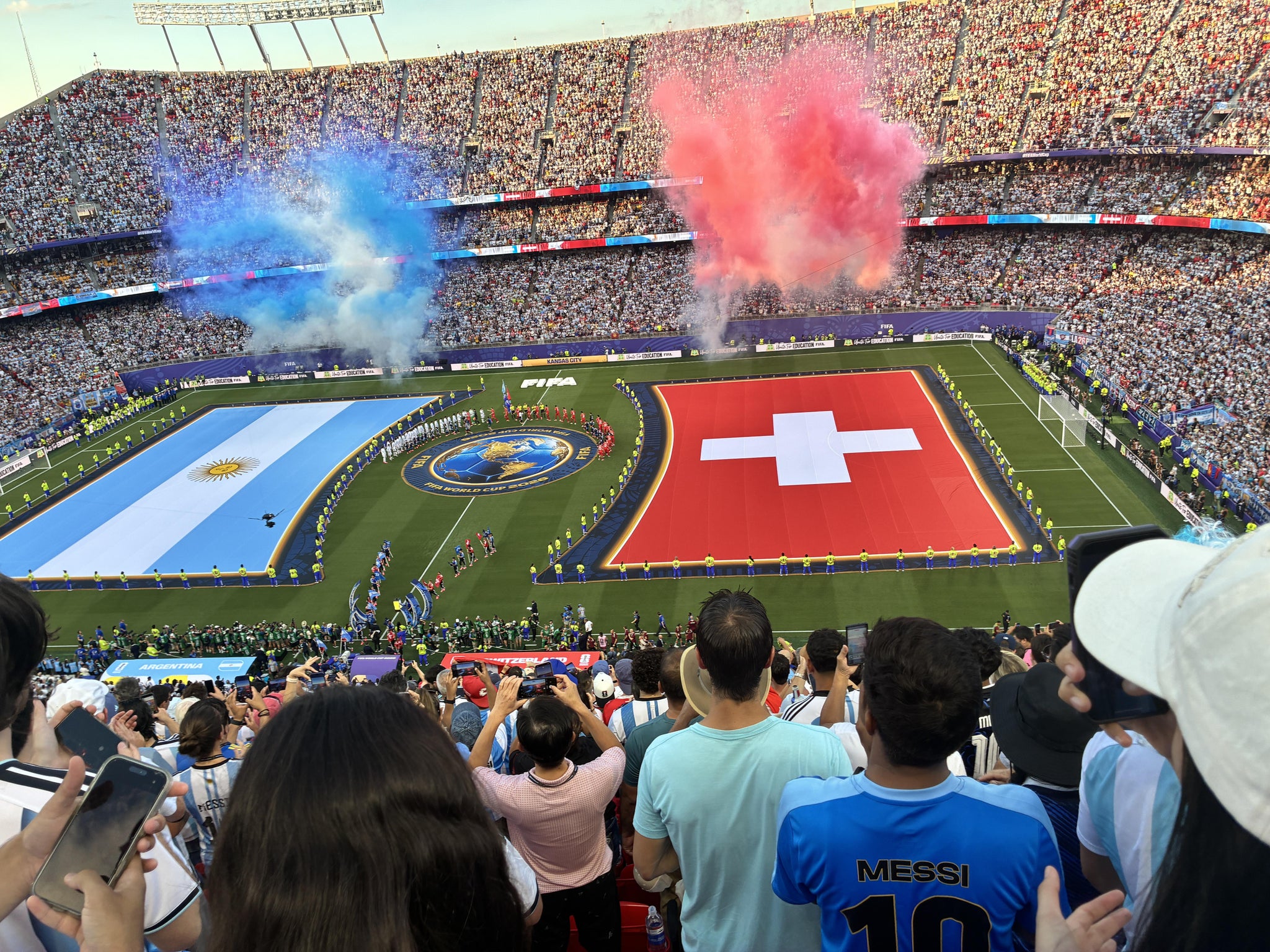
Millions of fans worldwide support the Argentine national team due to an emotional attachment and the intrinsic appeal of football culture spanning from the era of Diego Maradona to Lionel Messi.
Just because certain political leaders or armed organizations express support for Argentina does not justify concluding that all Argentina fans share those organizations’ or individuals’ political ideologies. Constructing such a narrative represents nothing more than a false generalization.
On the other hand, while the Spanish government’s political stance in support of Palestine may lead some people in Gaza to feel a greater affinity for and support the Spanish team, there are also numerous fans in Gaza who support Spain purely out of a passion for the sport, drawn by the Tiki-Taka style of play and the allure of La Liga clubs.
Automatically mixing political labeling with fan support violates individual autonomy in sports.
Another harmful manifestation of labeling and sweeping categorization is the systematic creation of false narratives aimed at tarnishing individual performance and historical achievements. This was clearly evident in the coordinated efforts directed against Lionel Messi and the Argentine team following the 2022 World Cup.
In the recently concluded 2026 World Cup, a loudly orchestrated narrative asserted that FIFA and referees were blatantly biased toward Argentina, that Messi enjoyed favorable treatment from officials, and that the tournament was orchestrated specifically for Messi to win the World Cup.
This represents an attempt to diminish Messi’s historic achievements through conspiracy theories while ignoring actual performance on the pitch.
Through algorithm manipulation on social media and exaggerated media headlines, the concept of “referee bias” was weaponized to stain Messi’s career and accomplishments.
Such actions dim the artistic and innate beauty displayed on the pitch, converting sports into weapons for political and personal attacks.
Social media narratives did not stop there; another fabricated narrative targeted Messi regarding political and religious matters.
Specifically, Messi was systematically labeled and accused of being a “supporter of Israel or Zionism.” Most of these allegations relied on misinformation and media exaggerations that diverged significantly from factual reality.
The primary image and detail used to label Messi as pro-Israel stem from a 2013 photo taken at the Western Wall in Jerusalem. However, this visit was part of FC Barcelona’s official “Peace Tour,” which included stops in both Israel and Palestine.
Prior to visiting Israel, Messi and his teammates visited Bethlehem in the West Bank, where they met Palestinian President Mahmoud Abbas and participated in football events with Palestinian children. Selectively cropping this event to portray Messi as a pro-Israel supporter is a clear attempt at distortion.
Furthermore, ahead of the 2018 World Cup, the Argentine team scheduled a friendly match against Israel in Jerusalem but ultimately canceled the fixture following concerns expressed by the Palestinian people and political pressure. Although the Israeli government and certain media outlets claimed Messi would play in Israel, Messi and his teammates did not go. Messi has also served as a UNICEF Goodwill Ambassador.
Another fabrication claimed that Messi donated €1 million to the Israeli military. This allegation was completely baseless misinformation that was officially debunked and rejected by international news organizations, including Al Jazeera.
These facts clearly demonstrate that accusations framing Messi as a “supporter of Israel or a Zionist” are fabricated narratives designed to politically exploit a athlete’s humanitarian tour and carry out systematic attacks.
Injecting a dichotomous worldview—the “black or white,” “ally or enemy” framing frequently used in politics—into the sporting arena destroys the social bridging power of sports.
The core essence of sports lies in its capacity to bring together fans of different nationalities, ethnicities, religions, and opposing viewpoints to collectively experience victory, defeat, excitement, and artistic beauty on the pitch, regardless of political disagreements or military conflicts among leaders.
Viewing sports purely through the lens of politics or hatred, and labeling teams or players as “good” or “bad,” effectively passes judgment on the fans themselves.
According to the social identity theory in social psychology, individuals possess multiple identities simultaneously. A football fan can simultaneously be a sports lover, a researcher, a religious believer, or someone holding distinct political views.
In modern sports sociology and international relations, the intersection of football (sports) and politics is analyzed from various perspectives. One perspective holds that football is not an isolated island separate from society, but rather a reflection of society that mirrors real-world geopolitical, economic, and racial realities.
Consequently, the spillover of external conflicts and nationalism onto the pitch becomes an almost unavoidable reality. Furthermore, governments and politicians frequently attempt to leverage football’s appeal to polish their image and cover up political issues through “sportswashing,” exploiting football as a tool of diplomacy and soft power.
In this context, it is equally important to note that keeping sports separate from politics does not mean athletes or fans must ignore injustices or remain entirely uninvolved in basic humanitarian matters.
Because athletes are part of society, the pitch can serve as a platform to express support for justice, human rights, and empathy.
For instance, during the 2017 Catalan independence referendum, FC Barcelona and players like Gerard Piqué courageously stood by the Catalan people’s democratic right to vote and freedom of expression.
Similarly, during the 2018 World Cup, former Arsenal player Granit Xhaka celebrated scoring against Serbia by forming the Albanian double-headed eagle gesture to commemorate the historic oppression faced by the people of Kosovo and Albania—an example of using sports to highlight justice and historical wounds.
Therefore, the true meaning of “not mixing sports with politics” is not to suppress the rights of athletes or fans to express empathy and justice in opposition to oppression and unfairness.
Rather, it is to oppose systematic labeling, the unnecessary propagation of hate, and political exploitation by governments, politicians, and certain media outlets seeking to capitalize on the beauty of sports.
It is essential to clearly distinguish between an athlete’s or fan’s positive stance in favor of justice and systematic political exploitation or labeling.
Football possesses a genuine ability to foster peace, bridge social divides, and unite diverse peoples across ethnic and religious lines in ways politicians often cannot.
Athletes and fans can use their personal freedom and positions to call for positive social change. When analyzing the intersection of sports and politics, while sports cannot be completely detached from external political realities, reducing the artistic essence of sports to a single political angle and labeling it destroys the true appeal and beauty of football.
To preserve the original meaning and scope of sports, it is necessary to acknowledge the diverse feelings of fans, respect the actual performance and talent of players, and accept differences rather than resorting to labeling to protect sports from political and hateful exploitation.
It is an undeniable reality that the 2026 World Cup involved commercial exploitation by FIFA, geopolitical framing by the host nation (the U.S. government), and corporate interests.
On the other hand, using structural economic and political issues to easily partition teams and players inside the stadium into “right/wrong” or “just/unjust” binary categories constitutes narrative exploitation driven by specific motives.
Narratives asserting that “Messi and Argentina represent injustice while Spain represents justice” merely shift systemic institutional issues onto an individual or a single team.
Labeling Argentina or Messi as “beneficiaries of an unjust system” similarly dumps the organizational shortcomings of sports bodies onto a single player.
Conversely, constructing a narrative that frames the Spanish team as a “symbol of justice” due to the Spanish government’s international political positions is equally a form of partisan framing that overlooks Spain’s footballing merits.
It is vital to understand that the Spanish team’s style of play and success stem from systematic training and tactical expertise, not political stances.
In the social media era, certain media groups construct war-style narratives of “the side of justice versus the side of injustice” in sporting events to capture human empathy and anger.
While the 2026 World Cup has concluded, the social media narratives grounded in politics and moral exploitation persist. Amid the economic and political complexities of the 2026 World Cup, no team or player—whether Argentina, Spain, or Messi—can be easily labeled as “justice or injustice.” Such partisan labeling represents political and moral exploitation that distorts the beauty and historical record of football.
About the Author