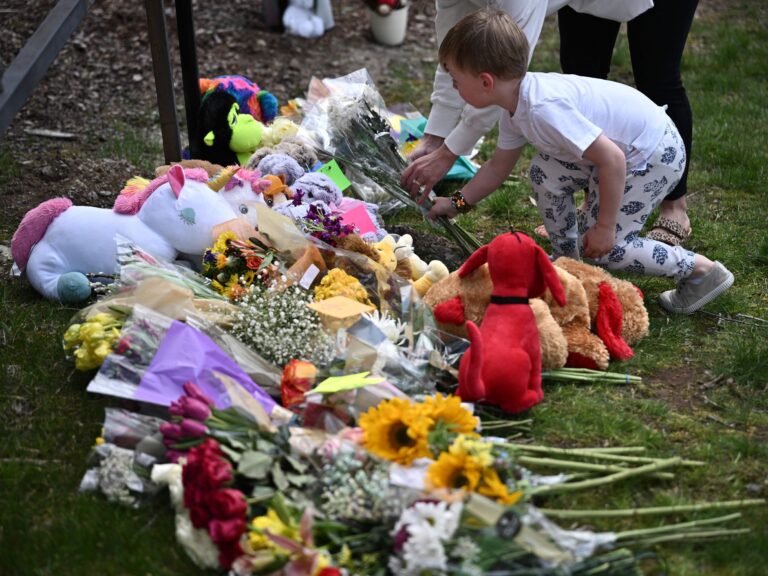

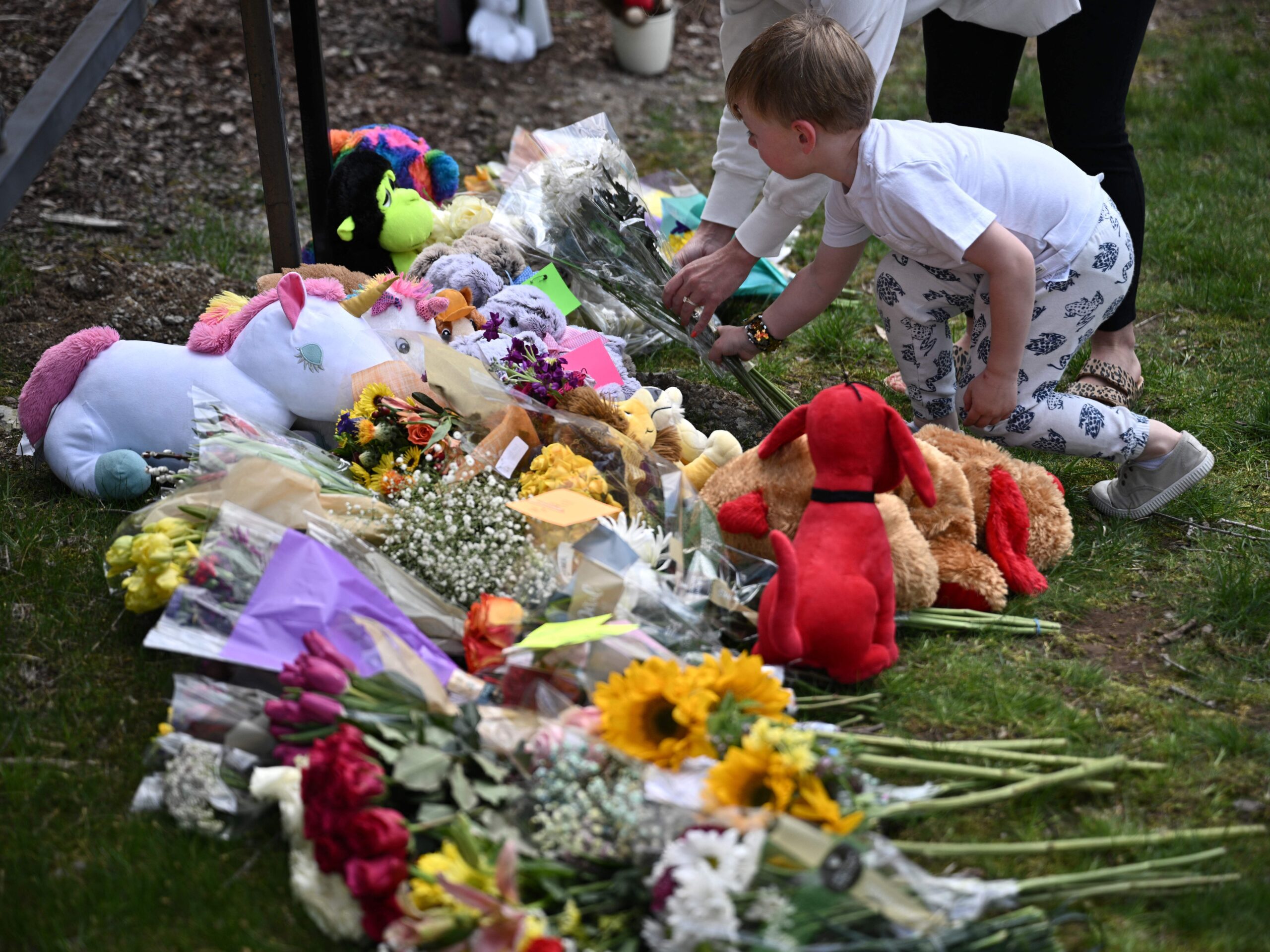
A boy leaves flowers at a makeshift memorial for victims by the Covenant School building at the Covenant Presbyterian Church following a shooting, in Nashville, Tennessee, March 28, 2023. - A heavily armed former student killed three young children and three staff in what appeared to be a carefully planned attack at a private elementary school in Nashville on Monday, before being shot dead by police. Chief of Police John Drake named the suspect as Audrey Hale, 28, who the officer later said identified as transgender. (Photo by Brendan SMIALOWSKI / AFP) (Photo by BRENDAN SMIALOWSKI/AFP via Getty Images)
Article | Burma Independent Voice
By Kyawat Maung
A school should be a place where children not only learn, but also build safety, trust, and bright futures. However, school shootings have increasingly dominated news headlines worldwide.
A shooting that occurred on August 7, 2026, at Debsirin Nonthaburi School in Nonthaburi Province, Thailand, deeply shook the foundational trust placed in educational institutions.
While exact details and casualty figures remain subject to ongoing investigation by authorities, initial reports from Reuters indicate that at least 9 people have died and over 20 others sustained injuries.
According to available news reports, a 14-year-old male student shot his grandparents at home before heading to the school, where he opened fire on teachers and school staff.
Dismissing this incident merely as an “impulsive act of violence by a youth” risks overlooking crucial aspects of the problem. The core question remains whether such incidents can be identified and prevented before they happen.
Global data underscores the growing insecurity within schools, raising questions among parents about whether sending their children to school feels safe anymore. While circumstances differ, incidents compromising school safety occur worldwide.
According to the Education Under Attack 2026 report by the Global Coalition to Protect Education from Attack (GCPEA), attacks on education rose significantly between 2024 and 2025. GCPEA documented attacks on education across 83 countries and territories during those two years, impacting at least 10,600 students, teachers, and education personnel.
Countries with the highest number of attacks include Colombia, the Democratic Republic of the Congo, Ethiopia, Haiti, Palestine, and Ukraine. However, in terms of total casualties and fatalities, Myanmar presents a particularly alarming situation.
Between 2024 and 2025 in Myanmar, attacks on education resulted in at least 80 deaths and 240 injuries among students and education personnel.
Myanmar’s situation is distinct because military junta airstrikes fail to distinguish between civilian and military targets, leading schools to directly become targets or collateral damage of air raids.
A key distinction exists here: while the incident in Thailand involved an armed individual entering a school, schools in Myanmar face the direct impact of armed conflict. Despite the differing nature of these threats, children and teachers remain the ultimate victims in both contexts.
This article focuses specifically on analyzing school shootings through a psychological perspective.
According to a 2024 research paper titled “A Systematic Review of K-12 School Shooting Research,” perpetrators in the majority of school shooting incidents exhibited warning signs or leaked their intentions beforehand.
While school shootings remain a distressing global concern, the United States accounts for the highest frequency compared to other developed nations.
A 2024 study published in Frontiers in Public Health, which examined 229 incidents in the U.S. between 1999 and 2020, compared actual shootings with averted plots. The study revealed that reporting systems and early tips from students proved to be the most effective mechanism in preventing attacks before they occurred.
In instances where fellow students noticed suspicious behavior and could report it through trusted, reliable channels, shooting plots were successfully thwarted.
When school shootings occur, society frequently leaps to the simple conclusion that “mental health issues” are the sole cause. However, research points out that school shootings do not stem from mental health problems alone, but rather from a combination of factors including social isolation, bullying, family conflict, environmental violence, and access to firearms.
In a 2026 systematic review by Michela Minelli and colleagues analyzing available study data, among perpetrators where mental health symptoms or conditions were documented, an average of approximately 34% had mental health disorders. On the other hand, studies with data on social isolation noted that roughly 71% felt isolated or were socially withdrawn.
However, these percentages should not be taken as a fixed or universal profile for all school shooters, as researchers note the difficulty of establishing generalized percentages across all perpetrators.
Therefore, rather than explaining school shootings through a mental health lens alone, it is essential to consider a combination of risk factors, including social isolation, bullying, family conflict, exposure to violence, and access to weapons.
According to the Systematic Review research, approximately 54% of shooters exhibited signs of psychological distress, and around 44% had a history of social rejection. Most shooters act not due to substance abuse, but rather through a combination of social isolation, experiences of bullying or mistreatment, family conflicts, environmental violence, and access to firearms.
Researchers further emphasize that there is no single, universal profile for school shooters, as environmental factors play a major role. Therefore, rather than labeling certain children as inherently dangerous, recognizing early warning signs of risky behavior is far more critical.
The incident in Thailand raises serious questions regarding how a 14-year-old obtained a firearm. Reports from the AP indicate that the gun used belonged to the teenager’s grandfather and was legally registered.
This brings up questions beyond gun ownership policies—such as how securely legal firearms are stored in homes to prevent minor access, and whether behavioral warning signs stemming from familial trauma or violence were recognized in time. Various studies point out that weak gun laws and easy access to firearms serve as major environmental risk factors elevating the likelihood of school shootings.
Following school shootings, authorities often implement immediate measures such as increasing armed security personnel, installing CCTV cameras, locking down facilities, and enforcing zero-tolerance policies.
However, research findings caution against these approaches. Zero-tolerance policies and overly harsh disciplinary measures fail to protect students and often drive individuals further toward punitive exclusion.
Placing armed security personnel inside schools has not been shown to reduce casualties, and in some instances, death rates were actually higher. Furthermore, active shooter drills can elevate anxiety and depression levels among students.
Instead, implementing anonymous reporting systems—allowing students to safely report suspicious behaviors—alongside flexible multi-option protocols reduces casualties while minimizing psychological stress.
To gain a deeper understanding of school shootings, researchers including Michela Minelli conducted a systematic review of 13 studies selected from 1,862 papers published between 1900 and 2024 that met rigorous criteria.
This systematic review identified recurring profile indicators among school shooters, including gender, age, family background, and mental health factors:
- Demographics: 97% of perpetrators were male, with an average age of 19.4 years. Racial demographics included White (56%), Black (40%), Asian (10%), and Hispanic (8%), with most perpetrators being socially isolated.
- Social and Family Background: 50% had experienced bullying, 71% reported feeling socially isolated, 72% experienced parental conflicts, and 42% had suffered romantic rejection.
- Psychological Indicators: 55% exhibited symptoms of depression, and 34% had underlying mental health conditions. However, only 38% had received mental health treatment prior to the shooting.
- Behavioral Clues: Crucially, 68% of perpetrators communicated their intentions or dropped warning signs prior to the attack. Additionally, 83% demonstrated poor problem-solving skills, and 94% exhibited low psychological resilience.
Researchers concluded that there is no single profile for a school shooter; rather, incidents stem from a complex convergence of social isolation, trauma, family difficulties, and access to weapons.
Although the incident in Thailand differs culturally and legally from those in the United States, the fundamental question remains identical: how can these events be identified and prevented before they occur?
Rather than labeling a student as a “troublemaker,” communities must ask what struggles the student is experiencing and what support they require. True school safety cannot be built merely with iron gates, surveillance cameras, and armed guards.
Parents send their children to school expecting them to learn in safety, and no family should ever have to face the tragedy of a child failing to return home. Ensuring safe educational environments is not just a concern for parents, students, and teachers—it is vital to the future of society as a whole.
About the Author