
June 10, 2026 | Burma Independent Voice
By Wai Ya Mone
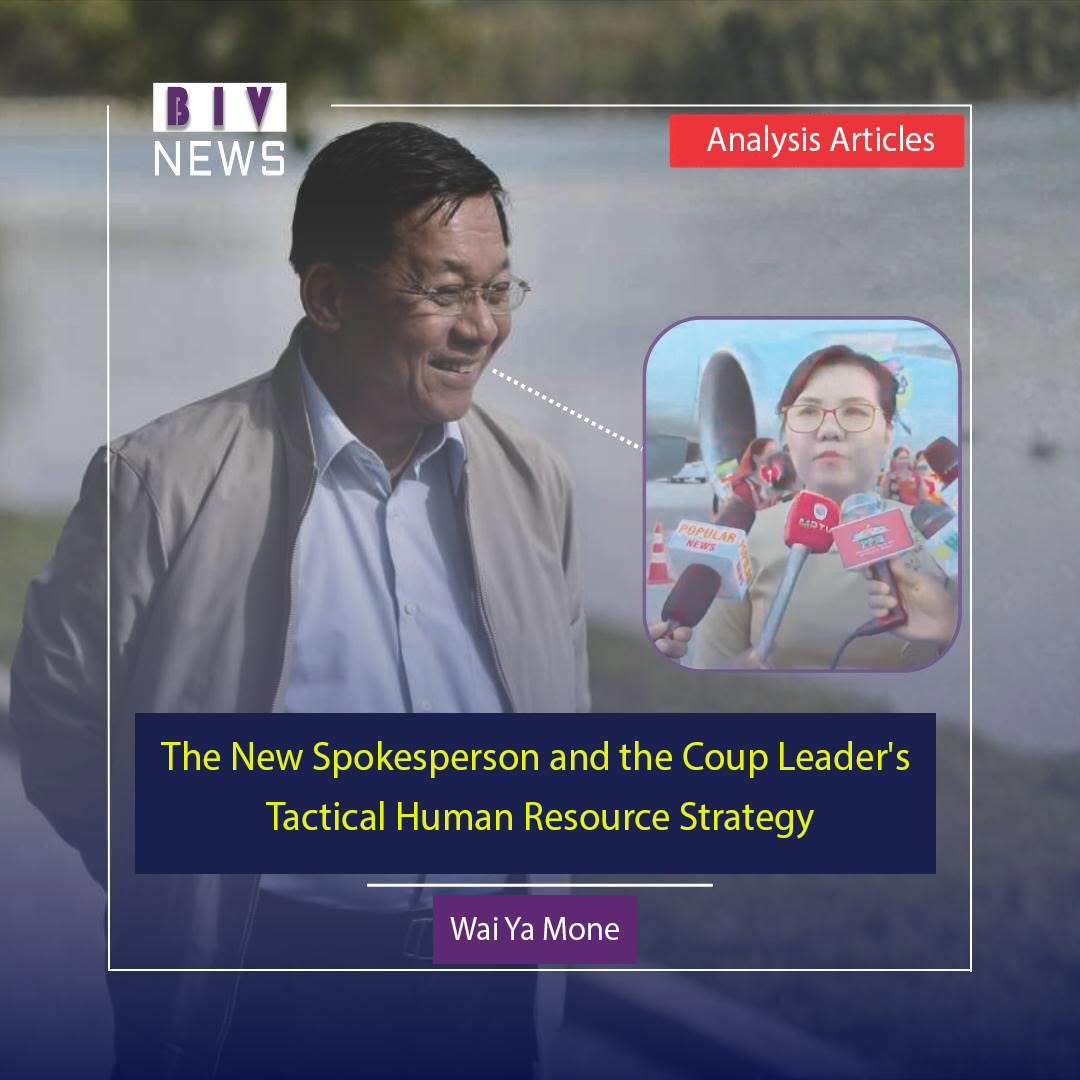
The newly appointed spokesperson for coup leader Min Aung Hlaing, Daw Khine Khine Soe, remains under an intense media spotlight, dominating domestic news cycles and capturing widespread public attention. Following the abrupt dismissal of her predecessor, Major General Zaw Min Tun, speculation and public interest regarding the regime’s next choice for its public face had reached a fever pitch.
In international political governance, the role of a spokesperson is universally recognized as highly sensitive, serving as the direct interface between the state, the citizenry, and the press. Consequently, world leaders rarely approach this selection lightly or based on mere convenience.
Historically, successive administrations in Myanmar have selectively appointed articulate, media-savvy men perceived to possess the capacity to foster positive public relations. Conventionally, these individuals were military veterans structurally drawn from the Ministry of Information.
During the President Thein Sein administration, presidential spokesperson U Ye Htut, a graduate of the Defense Services Academy (DSA) Intake 22, went on to become the Minister for Information in 2014. U Ye Htut served as the presidential mouthpiece from 2013 to 2016. Following his tenure, U Zaw Htay, then a director at the President’s Office, was elevated to the post. U Zaw Htay, a graduate of DSA Intake 37 who served in the military until 2007, subsequently retained his position as the official spokesperson for the President and the President’s Office under the National League for Democracy (NLD) government in 2016.
A defining characteristic of both U Ye Htut and U Zaw Htay was their ability to engage the public not merely through formal institutional communications, but through their personal literary pursuits, establishing substantial independent readerships. U Ye Htut authored commentaries under his birth name, while U Zaw Htay engaged audiences under the well-known pen name “Hhmuu Zaw.”
The current military regime’s selection strategy marks a radical departure from past historical patterns. Daw Khine Khine Soe, the civilian woman now under heavy scrutiny, has no prior record of active military service, though media reports indicate she is married to a senior military officer.
While this marital connection establishes a peripheral link to the defense establishment, her appointment is structurally anchored in her bureaucratic ascent within one of the state’s most critical portfolios serving as the Deputy Minister for Immigration and Population. Thus, her elevation to the role of spokesperson is a highly calculated administrative maneuver.
However, given that Daw Khine Khine Soe does not hail from the Ministry of Information the traditional breeding ground for state mouthpieces and possessed no prior public profile, deeper questions emerge regarding the strategic imperatives driving her appointment by the coup leader. To attribute her promotion solely to her marital ties to a military official is to rely on an overly simplistic assumption.
Unlike the Ministry of Information, which primarily manages the secondary dissemination of state media, the Ministry of Immigration and Population (MoIP) is a frontline bureaucratic apparatus that engages directly with the populace on a daily basis.
Prior to the 2021 coup, Daw Khine Khine Soe served as a Director within the MoIP. By February 2025, she was elevated to Director-General of the Department of Population, before eventually ascending to Deputy Minister in 2026. Crucially, her career trajectory positioned her as a central figure in orchestrating the 2014 and 2024 national censuses, rendering her a master of the country’s demographic data.
In the arithmetic of political transitions, census data is the foundational cornerstone of electoral engineering. Consequently, a demographic expert of Daw Khine Khine Soe’s caliber represents a critical strategic asset a “wildcard”,for the regime as it seeks to orchestrate upcoming elections and manufacture external legitimacy. Her technical competence is vital for validating the integrity of voter registries derived from census metrics, allowing the regime to defend its data structures against external skepticism.
Given that the military’s foundational narrative for the 2021 coup was anchored in allegations of widespread electoral fraud, placing a demographic and data expert at the forefront of its communication apparatus is a sophisticated strategy. It allows the State Administration Council (SAC) to inject technical data into its public diplomacy, attempting to project a veneer of administrative legitimacy over its roadmap. Furthermore, this indicates an attempt by the regime to transition its public messaging from purely militaristic rhetoric to data-driven, bureaucratic assertions.
Beyond the technical dimensions, the appointment of a civilian woman to a position traditionally monopolized by uniformed or recently retired military men serves a distinct optical purpose. It represents a perception management strategy aimed at softening the visual projection of an otherwise hardline military dictatorship. This calculated shift is designed to appeal to regional political entities and international observers looking for signs of institutional normalization.
Equally significant are her academic credentials. Having earned her doctorate from Mahidol University in Thailand, Daw Khine Khine Soe is uniquely positioned to serve as a diplomatic bridge to Bangkok. Her background offers the regime a more sophisticated channel to engage Thai authorities, potentially leveraging Thailand’s diplomatic offices to advocate for the junta’s re-entry into core ASEAN frameworks.
This appointment aligns with another recent, calculated bureaucratic placement. Prior to Daw Khine Khine Soe’s elevation, Dr. Thant Zaw Lwin—who holds a Master’s degree from Mahidol University and a doctorate from Chulalongkorn University in Thailand—was appointed as the Deputy Minister for Social Welfare, Relief, and Resettlement.
As Naypyidaw attempts to recalibrate its diplomatic relations with Bangkok, placing Thai-educated technocrats into pivotal state roles cannot be dismissed as mere coincidence. In the calculus of geopolitics and international diplomacy, accidental alignments rarely exist.
For Thailand, Myanmar represents an expansive, contiguous neighbor with deeply intertwined economic, trade, and border security interdependencies. Following the 2021 coup, Bangkok initially adopted the posture of a cautious bystander, avoiding definitive interventions in Myanmar’s internal conflict.
However, following the regime’s heavily controlled electoral processes, Thailand has noticeably stepped up its engagement. Notably, the first foreign signatory to pay an official state visit to Naypyidaw following the coup leader’s assumption of presidential duties was the Thai Foreign Minister a clear indicator of Bangkok’s re-engagement strategy.
Given Thailand’s position as a frontline state managing cross-border migration and complex refugee dynamics, its foreign policy posture carries immense weight in shaping Myanmar’s broader regional standing. In rebuilding this critical relationship, Daw Khine Khine Soe’s expertise in demography, coupled with her familiarity with Thai institutional culture, transforms her from a conventional spokesperson into a strategic asset capable of facilitating complex cross-border stability and security dialogues with Thai officials.
The coup leader’s approach to human resource management is ruthlessly pragmatic; he demonstrates zero hesitation in purging personnel the moment their strategic utility expires. The downfall of her predecessor, Major General Zaw Min Tun who, despite his absolute loyalty and military uniform, was discarded when his narrative effectiveness waned stands as a stark testament to this dynamic. For the junta leadership, appointments are governed strictly by immediate political survival and strategic expediency.
In conclusion, dismissive public reactions that frame Daw Khine Khine Soe through the same satirical lens applied to her predecessor labeling her a mere “puppet” or anticipating routine falsehoods risk obscuring the highly strategic nature of the regime’s personnel choices. A rigorous, objective assessment reveals that the SAC’s human resource allocation has grown increasingly sophisticated.
At this juncture, the coup leader is actively executing a series of calculated maneuvers to secure regional integration and international recognition. Rather than viewing the new face of the regime as a subject of mere ridicule, analysts and opposition forces must critically evaluate the evolving strategies driving the military’s domestic and international propaganda apparatus.
Wai Ya Mone is a political, conflict, and security analyst.
About the Author